 |
| Jean-Paul Belmondo worshipping at the shrine |
Before The Maltese Falcon Humphrey Bogart was a bit player—mad scientist, Irish groom, third thug. He stepped up when he played Duke Mantee, a part evoking Dillinger, in The Petrified Forest on Broadway, to Leslie Howard’s T.S. Eliot-soaked poet.

There was an audible gasp when Bogart came onstage, so persuasive was he. But for the movie Warners wanted Edward G. (Ah, producers!) Howard however said he wouldn’t do it without Bogart, who later named his daughter Leslie Howard.
But for the next five years he was still supporting cast. When George Raft, who the director fought for, turned down the part of Mad Dog Roy Earle in High Sierra, Bogart got up to bat—an ex-con, sucker for the wrong girl, dead in the shoot-out, but the lead.

Huston, about to direct his first movie, had the idea of starring gangster-face Bogart as the detective-hero. He gave hit novel The Maltese Falcon to his secretary to type up as a script, and a few days later bumped into Hal Wallis, who complimented him on it (Huston never found out how he got it), but wanted George Raft. Raft didn’t want to work with a first-time director (hah!) and turned it down.
The casting was brilliant: Peter Lorre from Murnau and German Expressionism, new at Warners; Sidney Greenstreet from Shakespeare and the English music hall, in his first film at sixty-two; deliciously feminine Mary Astor, articulate and tricky; and Bogie, toughest of tough guys, spit-in-your-eye insolent and enjoying it.
(suddenly jumps up and shouts down at the DA)
Now both you and the police have as much as accused me of being mixed up in the other night’s murders! Well, I’ve had trouble with you before, and as far as I can see my best chance of clearing myself of the trouble you’re trying to make for me is by bringing in the murderers all tied up. And the only chance I’ve got of catching them and tying them up and bringing them in is by staying as far away as possible from you and the police because you’d only gum up the works!
(to the stenographer, softer tone)
You getting this all right, son, or am I going too fast for you?
It’s a gorgeous film. (See Gorgeousness.) Dashiell Hammett, who wrote the novel (there are only two passages that aren’t in the script), was of the “hard-boiled” school, Hemingway guys, like Huston (see Hemingway for Wimps). Toughness is scarcely my pose, but this film is exquisitely made. There isn’t a shot that doesn’t give pleasure.
Nor am I pro-puritanism (on which I can be intensely boring—see Catholics and Puritans), and Sam Spade is a portrait of the Puritan in action.
The core of the ethic—I’ve got Max Weber’s book open as I type—is “one's duty in a calling.” Spade excels as a detective, and that’s all he wants. He turns the love of his life over to the police, he tells her, because he is a detective, and when someone kills your partner you’re supposed to do something about it, or it’s bad “for all detectives, everywhere.” She laughs at this. “Don’t be silly,” he says, “you’re taking the fall.”
Like Christian in Pilgrim’s Progress he trusts no one—not his woman, not his friends, not at least until he’s secured his own salvation. And the money he earns he doesn’t dare enjoy.

I remarked elsewhere that “cool” is a Protestant virtue, the Puritans riding in disciplined formation against hit-and-miss Cavaliers motivated by passion and beer. Sam keeps a distance between himself and his emotions. He pretends to get angry but it’s for show; as soon as he’s alone he laughs at the performance. And he won’t protect the woman he loves “because all of me wants to.”
Then he adds up the reasons. “Maybe some of them are unimportant, I won’t argue about that, but look at the number of them.” Double-entry book-keeping. “And what have we got on the other side? That maybe you love me, and maybe I love you.” We’re in the red. God wants us to show a profit—that’s how we know we’re OK with Him.
Here we have the drama of the lonely puritan Making A Decision. We others go where life leads us. Honey, you killed him, you could kill me, good-bye—is that a choice? There are other fragile beauties who like to whimper while they’re being had—they need me too. Nothing to think about, really.

The Puritan, then (and this is our largest conclusion), is a Romantic—“an insecure, unsatisfied, impatient temper,” Joyce called it. There are no accidents here, no grace. Nothing is as admirable as luck, I like to think, but Sam doesn’t rely on luck. He despises this world of shame and compromise, and plucks up his skirts from it.
But then Sam is Something, not Nothing, like, for example, me.
Weber contrasts the end of the Divine Comedy, Dante standing “speechless in his passive contemplation of the secrets of God” (which reminds me of Lear to Cordelia, “And take upon us the mystery of things”), with the end of Paradise Lost: “The world was all before them”. Life is a task. Time to get to work.
And this above all: Thou shalt not be a fool. “I won’t play the sap for you!” His partner was a fool, and look what happened to him. It's a cautionary tale. Makes one fear for one’s own salvation.But then Sam is Something, not Nothing, like, for example, me.
Weber contrasts the end of the Divine Comedy, Dante standing “speechless in his passive contemplation of the secrets of God” (which reminds me of Lear to Cordelia, “And take upon us the mystery of things”), with the end of Paradise Lost: “The world was all before them”. Life is a task. Time to get to work.
The fake falcon he calls “the stuff that dreams are made of,” and these are the final words. You mean that’s it? For dreams, I mean? Very noir, very noir. “Kind of belief system," says Toby, "you pick up in a cold climate.”

In Casablanca, another one turned down by George Raft, Rick does play the sap, but only till he wises up and joins the war effort. This movie was made to explain to Americans why they were fighting in Europe. Rick is America—an isolationist, “I stick my neck out for nobody,” and in all things, even in love, a businessman (“A frank for your thoughts.” “In America they’d bring only a penny.”), but when he sells his bar and Signor Ferrari wants Sam thrown in he says, “I don’t buy or sell human beings”—the issue that brought about, to use Griffith’s phrase, the birth of a nation.
He's a wonderfully tough guy: “Can you imagine us in London?” “When you get there, ask me.” “How about New York?” “Well there are certain sections of New York, Major, that I wouldn't advise you to try to invade.” Can you hear the cheers?

And wonderfully smart-ass. “What in heaven's name brought you to Casablanca?” “My health. I came to Casablanca for the waters.” “What waters? We're in the desert.” “I was misinformed.”
The other men too have allegorical (which is to say one-to-one) meanings: the Gestapo major, the Czech underground leader, the Russian bartender, Vichy France as a discarded water bottle. Straight messages, like the old refugees on their way to America: “We speak only English now. Sweetness, what watch?” “Ten watch.” “Such watch!” Take care of these people.
The women on the other hand (are you listening girls?) are symbols, self-contradictory, bearing richer ranges of meaning. Yvonne may love Rick and flirt with the Russian and sleep with the German, but she’ll lead the Marseillaise passionately enough to get the bar closed.
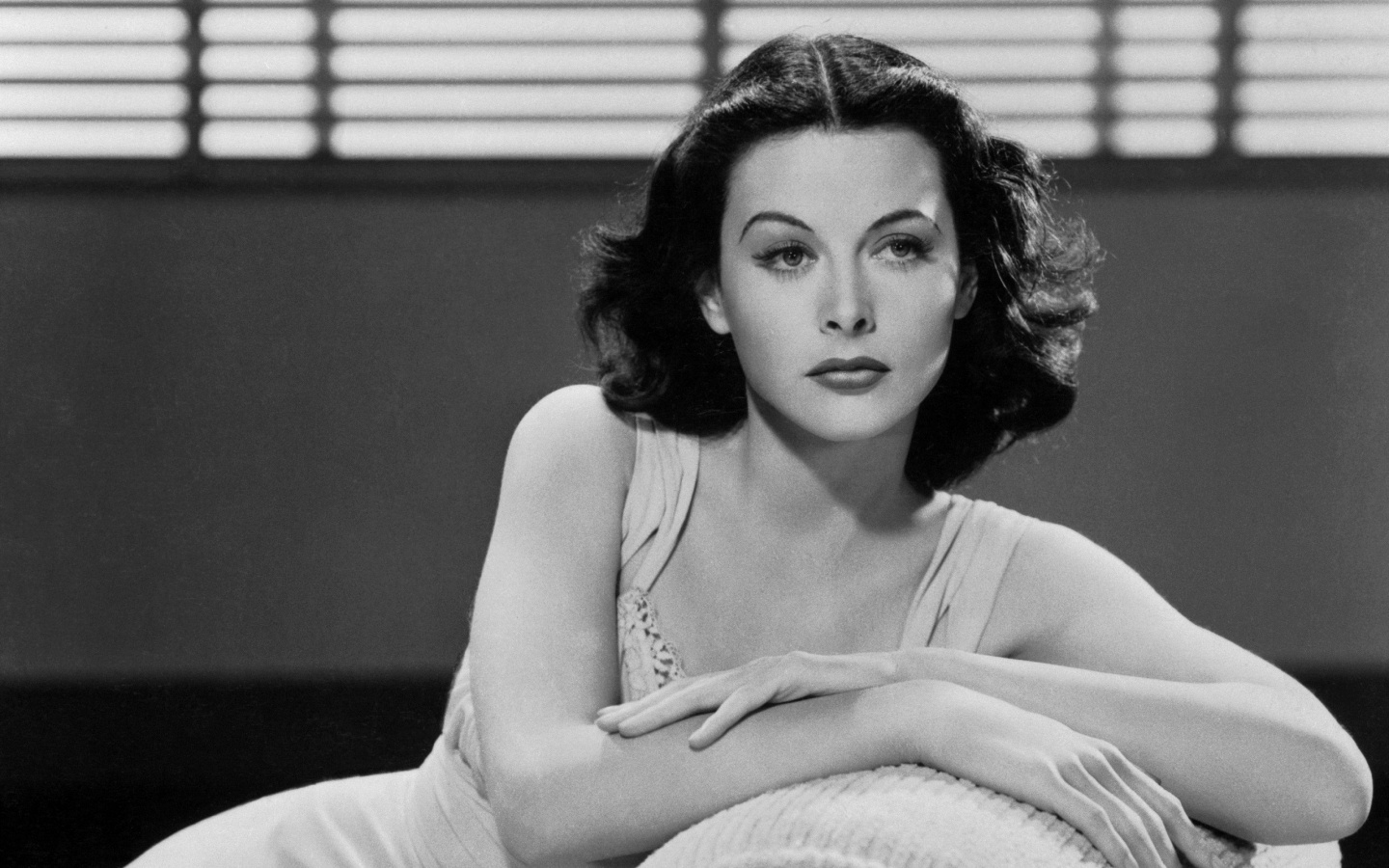
Casablanca is patterned on the equally superb Algiers, jewel thief Boyer hiding out in the Casbah. In walks bad-girls-go-everywhere un-not-lookable-at Hedy Lamarr with her rich protector. Boyer goes right up and asks her to dance, eyeing not her breasts but her jewels. “What did you do before you had these?” “I wanted them.”
With Casablanca Bogie entered mythology—tugging his ear, drawing his thumb across his lip, jerking it back from his teeth, staring down anyone who dared hold his gaze. Howard Hawks said, “I’m going to pair you with someone as insolent as you are.” Enter nineteen-year-old Lauren Bacall in To Have and Have Not. Bogie and Baby. She catches him pausing before he drops a passed-out woman on a bed: “Tryna guess her weight?”
Huston, though, having invented Bogie, dropped the figure—The Treasure of the Sierra Madre and The African Queen (Bogart hated Africa) are not Bogie movies—until Beat the Devil, which Bogart didn’t want to do because he knew it was mocking the myth. Script by Truman Capote. Jennifer Jones: “Harry, we must beware of these men. They are desperate characters.” “What makes you say that?” “Not one of them looked at my legs!”

In private Bogie was the same kind of guy. “No actor who ever played Hamlet,” he advised young Richard Burton, “died rich.” And he is said to have complained to Bacall that he wanted to live within his means. “Anyone who lives within their means,” said Uncle Oscar, “suffers from a lack of imagination.” When the IRS asked George Raft, who came from the other tradition, how he spent ten million dollars he said, “Part of it went for gambling, part for horses, part for women. The rest I wasted.”
Bogie’s final film paired Rod Steiger with him. “Never do an eating scene with a Method actor,” he said, “they spit all over you.”
The hard-boiled style (and Raft had a Mafia background) owes itself to Hemingway, whom I think so highly of—but have to defend myself against. Perhaps the final word, at least as far as my delicate psyche is concerned, is from Charles Bukowski, a tough guy himself. “Hemingway never danced,” he said. It was all struggle, all facing the bull.

I suspect my preoccupation with Puritanism comes from living in Greece. Around here Nordics are referred to as kriokoloi, cold-asses—passionless, never showing emotion. Cold-asses think culture is impossible unless you’re rich. They think wealth is having lots and lots of money (what the French call an embarrassment of riches). Class, baby.
To make money, of course, you need brains. To spend money you need culture. I have no brains at all, but I’m crawling with culture.
This isn't, however, to take sides. I am between these things. Not that life is ambiguous—we are incapable of sustaining ambiguity. As Wittgenstein said, you can see the duck, you can see the rabbit, but you can’t see both at once.

Sometimes this, sometimes that. My opinions sneer at one another.
So let me reveal the sentimentalist I in some phases am, and confess that my favorite rendition of As Time Goes By is by master jazz violinist Stéphane Grappelli (and don’t miss the piano solo), right here.
Robert MacLean is a bad poet and an independent filmmaker. His The Light Touch is on Amazon Prime, Tubi, Scanbox and YouTube, and his 7-minute comedy is an out-loud laugh. He is also a screamingly funny novelist, a playwright, a blogger, a YouTuber, a reviewer of films, a literary critic, and a stand-up comic poet. Born Toronto, PhD McGill, taught at Canadian universities, too cold, lives Greece, Irish citizen. He is of towering intellect but, as is often the case with such people, not that bright.


