Showing posts with label Hamlet. Show all posts

Fellini

Aesthetic emotion puts man in a state favorable to the reception of erotic emotion.  Art is the accomplice of love. Take love away and there is no longer art.—Remy de Gourmont
Theoretically, the perfect movie would combine Ford's framing, Ophuls' staging, Fellini's pacing, Visconti's production values and Lubitsch's wit.  But who lines up to see theories? 

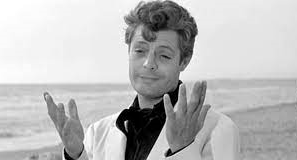
We don’t have to ask what the best thing is in any art— everybody knows.  What’s the greatest painting if not the Sistine ceiling?  The greatest sculpture?  The greatest play?  The greatest film?  Many people who bother to consider such things would say 8 ½; and indeed who is the axiomatic director but Fellini?
So let us stand the greatest play and the greatest film side by side: the melancholy Dane and the melancholy Guido.  Eternal high-school kid that I am, I’m always looking for a key to Hamlet.   Maybe this is it!

Like Hamlet, Guido is a new kind of man.  Hamlet Senior is modeled
on Achilles, as heroes had been for millennia, and still are.  “Strength and honor” is the salute in Gladiatorthe values associated with the heroic, and with pop culture.  If you’re not interested in tough guys most cinema is meaningless to you.

The ghost walks in armor, and he expects his son to do the heroic thing, because revenge is the epic motive.  Check your TV Guide.  But Hamlet just isn’t Achilles.  He can’t bring himself to kill Claudius—not that he lacks the murderous impulse.  In neighboring Norway Fortinbras, which means “Strong-arm,” is a replica of Fortinbras Senior.  Hamlet catches sight of Junior marching his army through Denmark to attack the Poles, and is full of admiration; but like all the masks Hamlet tries on, it just ain’t him.  No mask fits Hamlet ("I have that within which passeth show") but he can't represent himself without one.  Who can?  He is, as Harold Bloom says, something new.

Same goes for Guido, and for all of Fellini’s men.  When, in La Dolce Vita, Lex Barker punches Marcello for being out all night with Anita, Paparazzo says, “You’re not going to fight back?”  Marcello shakes his head.  No machismo for him.

Hamlet and 8 ½ both persuade us that the inner life can be portrayed on the stage, on the screen.  We had had to project that innerness onto the gestures and speeches of the actors; these works put it in our face. 

Like Hamlet Guido makes a film within a film, if I may so put it.  


Like Hamlet, he lifts his inner torment above the others, and resorts to irony when he deals with them, and indeed with himself.  Each of them is understood, in his respective world, by no one.

Like Hamlet Guido is haunted by his father, who climbs out of the grave and complains about the accommodations.  “How’s my son doing?” he
asks Guido’s producer, but the producer just shakes his head.

Like Hamlet he has an ambiguously erotic relationship with his mother.  


Like Hamlet's, Guido's dream girl turns out to be "a little bore," as he calls Claudia.

Like Hamlet (indeed like Shakespeare), his reality is shattered and lies there in pieces.  He has no synthetic power but in the vibrancy of each piece.  This seems to me a thread in the velvet of Shakespeare's "voice," so to call it, a note of surrender, a dying fall.

Like Hamlet Guido thinks a hundred thoughts, and none of them are really him.

Like Hamlet he’s a comedian, a monologuist, a clown and, like most clowns, a sad one.  The pair of them are self-pitying smart-asses.
Hamlet is a refined man.  He's been played infinitely differently, and several times by women, as Poldy remarks in Ulysses, but as many ways as we can imagine him, we can't think of him as vulgar.  Why not?  He is crass, dishonest, rash, cruel, murderousthere's hardly a disgrace he doesn't commit.  Ah, but that wit of his.  "So is it, if thou knew'st our purposes."  "I see a cherub that sees them."

Same for Guido, who never commits the vulgarity of action; it's all in his mind.  Fellini wasn’t happy with Marcello as his alter-ego, and made him have his chest waxed to be more refined.  I think he’d have preferred an Alain Delon or an Oskar Werner.  “Oh, Maestro, Marcello again?” say the spirits, mocking him (as when do they not?) in City of Women.

Like Hamlet Guido lives in a world of spirits—in his case Italy, where ancient presences from the pagan panoply that underlies Catholicism roam the earth, and know his thoughts.  "There are more things in heaven and earth, Horatio, than are dreamt of in your philosophy."

Like Hamlet he's blocked by his contradictions.  “And in my heart there was a kind of fighting.”  Guido answers yes and no to every possible question.  “Do you have children?” says the Cardinal.  “Yes, I mean no.”  This too is post-heroic.  The hero is always yes or no, zero or one: only one man comes back from a gunfight.  “Decide, Guido!” his producer shouts as they view the screen tests; “Choose!”  Guido can’t.  He is not the decider. 

At the station he throws away his collaborator’s ruthless critique of his script, then picks it up and reads it again.  This is a scene he stole from Buster Keaton (Leone used it too, at the beginning of Once upon a Time in the West): the train leaves, his mistress hasn’t arrived, he’s relieved and gets up to go, but as it pulls out there she is in white fur trimming.  “Yoohoo!”  He looks around; does anybody see?

Then he takes her back to his room and has her perform his sexual fantasies.  For once he’s a director who knows what he wants.

Like Hamlet, Guido knows the self is not socially acceptable.  They free us from Christianity—that won’t work for either of them.  Hamlet, murderer of men, torturer of women, frees us from sin, negates sin.  It no longer matters.  Yet we have no doubt of his metaphysical validity.  (I don’t want to say “salvation”—Christianity doesn’t work for me either.)  The redeemer as smart-ass.

And what is Guido if not an impotent god?  Both of these men are open-topped.  They communicate directly with—what?

Happiness, Guido says, is being able to tell the truth without hurting anybody.  His sensuality is all that interests him.  He's not a Christian, saints be praised, but he’s Catholic, and confession is part of his style.  The screen tests in 8 ½ are confessions to his wife.  Everything he does is a confession.  When he goes down into the Dante-esque steam room to interview the Cardinal all he can do is confess“Father, I am not happy.”  “You’re not here to be happy,” says the Cardinal with some justice, but then he quotes Origen, the Church Father who castrated himself: “There is no salvation outside the Church.”  And there is Guido, outside the Church.

Ah, he’s down.  But at the end, the uplift!  “What is this flash of joy that’s giving me new life?”  I have mentioned 
elsewhere that the Protestant inclines to schizophrenia, and the Catholic to manic-depression.  Guido’s spirits simply lift, and we have his vision of a latter-day Communion of Saints.

But humility, charity—don’t look for them in Hamlet.  Don’t look for them in Guido.  “He never gives, nor lends, nor trusts,” the feminist judges say of Snaporaz.  Early on Fellini worked under the yoke of Neo-Realism, which he subverted at every opportunity.  Social reality interested him not even slightly, but it was the only game in town. 

In Il Bidone Broderick Crawford plays a con man disguised as a priest.  There’s a touching moment when he’s asked to comfort a wheelchair-bound teenager, who tells a sad story.  He shrugs—at her, at the whole movement: “You don’t need me.  You’re much better off than a lot of other people.”  When he and Richard Basehart are milking a village Basehart smiles at an urchin, a perfect Neo-Realist poster, but “You look like a little devil,” he says.  Devils are what we seem to be in Fellini.  “And the bravest of the devils said ‘I’m going to get into the labyrinth!’” Giulietta tells the kids in Juliet of the Spirits.

Not that he took evil seriously.  When the Fascists fill his father full of castor oil, which in fact was their practice, to humiliate him by making him shit himself, the young Fellini, and the older Fellini, think it’s a big joke.  An American bombing raid forces him and his Roman hosts from their dining tables in the street into an air-raid shelter; but you can meet some good-looking women down there.

“There’s a divinity that shapes our ends,” Snaporaz quotes in City of Women.  I don’t know how deeply the Maestro read in Hamlet—he didn’t like to be thought of as an intellectual.  And Toby Dammit, the Englishman in Rome, gives us just enough of Macbeth’s “Tomorrow and tomorrow” to let us know that he’s a tragic Nordic.   These schizos; if you want to get where you’re going you can’t take your head.
Most of us think Hamlet is Shakespeare’s greatest work, and 8 ½ Fellini’s.  (Thank God for black and white.)  (Thank who?)  Everything else Fellini did is episodic—breaks into episodes that can be eliminated without affecting the story.  This, as Aristotle told us, is bad for business, and relegates those films to what we currently call art-house status.  Only plot sells: not beautiful language, not beautiful shots, not beautiful stars; plot.  Which is to say because, not and then.  The king died and then the queen died, said W.H. Auden, is a story; the king died and then the queen died of grief is a plot.

In his first solo-directed feature The White Sheik Fellini did give us a unified plot: provincial newlyweds come to Rome to meet his family and she gets lost and winds up with a photo-roman hero she's always adored, played by the superb Alberto Sordi.  (Woody Allen took this for one of the strands of To Rome with Love, and has a Sordi look-alike for the star.  So fond was Allen of the piece that, though it’s only a day-long thing, he edits it in with other strands that carry us through weeks, as if they were happening simultaneously.)

Apart from that one, in Fellini’s work, only 8 ½ is all of a piece.

Of course Guido’s Catholic upbringing has repressed him.  Enter Freud.  To clog the intelligence with an idea is un-Shakespearean, so here ends the resemblance to Hamlet, which may be construed as a systematic flushing of ideas.  We enjoy them as we evacuate, but this is nothing to the postpartum levity; Hamlet, like Guido, feels lighter in act five.  Ideas, to change the metaphor, or perhaps not, are fireworks displays, illuminating the terrain for a momentexisting for their own glory, then vanishing.  (I like the Irish-accent pun in Finnegans Wake: “when they were jung and easily freudened.”)  

Hamlet renounces all precedent, but Fellini is a classicist.  The art historian Kenneth Clark said that one of the aspects of classicism is smoothness of transition.  Few films are as smooth as 8 ½. 

Classicism is Fellini's moral touchstone.  At the end of La Dolce Vita Marcello and his cronies invade a friend’s beach house for an orgy, and when the owner returns he is amused, tolerant; but when they start breaking things he throws them out.  He is a balanced man, a classical man, and we meet him again in Satyricon, the aristocrat who, now that everything is falling apart, frees his slaves, sends his children away to safety and commits suicide with his wife.  Do with the house now what you want.  Does Fellini approve of Marcello's orgy, of Encolpio's ambisexualism, of Casanova's exploits?  Yes and no.

Dante inspires 8 ½ as Piranese, the ultimate designer of labyrinths, does City of Women, and the labyrinth is Fellini's image of human existenceIn the castle maze of La Dolce Vita Marcello and Anouk Aimée make contact by voice through an acoustic whatsit and exchange words of love while she makes it with another guy.  In Satyricon's Cretan-style labyrinth the murderous Minotaur turns out to be a joke.  Like Icarus Guido wants to fly, Toby Dammit wants to fly, Snaporaz wants to fly.

People who argue that Shakespeare wasn't pornographic cannot have read Venus and Adonis.  Man delights not me; no, nor Woman neither; though by your smiling you seeme to say so.”  Sounds like he's been there, though.

Fellini's sensuality is all-consuming, and in this he and his compagni are fixed entities.  Change! says Snaporaz to the feminists; Into what?  A  journalist shouts to Guido, “Is pornography the most intense form of entertainment?”  Sylva Koscina's performance as the sexy sister in Juliet of the Spirits removes, for the moment, doubt.
Hamlet by contrast is a master of change.  The purity of total change is hypnotic in him, as long as it isn’t moral.  

What a pair of rapscallions!

Of course art is not moral.  Morality is intention.  In Roman Catholic sin-ology the intention makes or unmakes the sin.  In art intention counts for nothing.  You make a film, Jean Renoir said, to find out what it will look like.  In Hollywood movies intention counts for everything.

The only other filmmaker we can compare to Fellini is Luis Bunuel, and both are Freud guys.  For both it comes down to the sexual impulse.  Which, sure.  Both do fantasy and dream, and blur their borders with reality.

Bunuel is a great poet.  In The Discreet Charm of the Bourgeoisie a boy’s dead mother calls to him from the closet where her clothes sway.  As a kid I never had such a strong sense of my mother’s presence as when I went to her closet, opened the door and smelt the perfume.

Bunuel made for me what is the ultimate horror film.  Most people find The Phantom of Liberty funny.  (This is the one where people sit on toilets at the dinner table, and escape to the bathroom to eat.)  But he so accurately gets the entrapment of dreaming, which leads us by association from this to that in a way entirely beyond our control, that it frightens me.

But superb as he is, he is as cold as Velázquez.  Fellini, as I don’t have to tell you, is warm warm warm.  He mocks himself for his nostalgia, but it’s no less compelling for that. 


Guido is tender.  Hamlet is sensitive, but he’s not tender.  Falstaff is tender.  Lear, at the end, is tender.  Not Hamlet.  (“Think yourself a baby That you have ta'en these tenders for true pay, Which are not sterling.”) 

To Giulietta’s dismay Federico was active in the field of love, but he didn’t see himself as a man of action: “I am the only one I know,” he once said, “who can admit that it’s all fantasy.”  The man of action he satirized in Casanova.
To his fantasies Fellini gave the classical form of goddess-worship.  The labyrinth is where you don’t know what’s going on.  As the Goddess tells Roberto Benigni’s holy fool in Fellini’s last film, The Voice of the Moon, he’s not supposed to know what’s going on.  “You do not have to understand.  Woe to him who understands,” she says, and she has the last word.  I don't know if that would satisfy Hamlet, but he does, in the fifth act, seem at peace with the divinity who directs him.
The holy fool is a figure Fellini had cultivated in the Neo-Realist days, possibly because Giulietta—indomitable, wide-eyed with wonder—was so adept at playing it.  Does Zampanò abuse her?  All people have value, Il Matto tells her, one holy fool to another.

When Fellini lost interest in his fantasies his films, for me, flattened out.  We want the refugees saved in And the Ship Sails On, but I can’t sit through it, or Ginger and Fred, or Intervista, not again anyway.  In The Voice of the Moon he returns to the holy fool, and it does have moments of charm, but as Rabelais said, “Now my innocence begins to weigh me down.”

Then again, at the end of his life Shakespeare is supposed to have collaborated on Henry VIII.  I can’t get through that either.

I know that when I discuss these things I’ll lose them, and that’s partly why I do it, to exorcise them and free my own voice.

At his best Fellini was the most exuberant, the most generous, the most gorgeous of filmmakers.  And where would we be without gorgeousness?

Bob, what a wonderful piece! Thank you. I think Fellini would have chuckled at it, in a good way.  
Thanks again,
Paul Mazursky

Comments? Right here.

Robert MacLean is a bad poet and an independent filmmaker. His The Light Touch is on Amazon PrimeTubi and Scanbox, and his 7-minute comedy is an out-loud laugh. He is also a screamingly funny novelist, a playwright, a blogger, a YouTuber, a reviewer of films, a literary critic, and a stand-up comic poet. Born Toronto, PhD McGill, taught at Canadian universities, too cold, live Greece, Irish citizen. Committed to making movies that don't matter. No brains, but an intellectual snob.

Frankly, I forgive myself.

In Bed with the Girls

The Light Touch on Amazon Prime

Film reviews: Hillbilly Elegy

The Natural Wish to Be Robert MacLean


What We Know, an Excursion into Unscience

Make that what you know.  (I address these remarks to the mirror.)

Not much.

Science is Latin for “knowledge,” and we walk around in a trance of confidence that “science” understands the things that we don’t, and can and will solve all the problems.  This attitude is called “scientism.”

What, then, do you really know?

Let’s start with what you see when you open your eyes: light.  “Everything that is,” said Duns Scotus, “is light.”  What is it?  Particles?  Of what?  Waves?  Vibrating what medium?  Much debated.  If it’s particles, how does it get through glass?   If it’s waves, how does it reach us through ninety-three million miles of vacuum?  


Maybe it's dark matter, the Darth Vader hidden behind appearances—sort of a Zoroastrian evil twin!

The Wikipedia says, “light can be expressed as both particles and waves. This paradox is known as the Wave–particle Duality Paradox.”

You see?  There are people who understand.  But they don’t want to talk to you.

Note the word “paradox,” the language of the medieval Church.

OK, what about real matter?  Substance.  Stuff.  The hand before your face.  What is it?

You feel certain, I know you do, that it’s made of molecules and atoms.  If you want to get real refined about it, it comes down to quarks (James Joyce be praised!) and other “subatomic particles.”

Hah! 

You’ve been sold the fifth-century-BC Greek atomic theory.  And it’s still a theory.  If that little solar system with electrons orbiting a nucleus did exist, the nucleus, I understand (there, I understand something!), would be like a baseball on the floor of a cathedral, the electrons flies in the upper reaches of the vault. 

If.

We live in a world of metaphor—“nuclear” power, “atomic” bombs, “electricity”—for what is electricity?  “A flow of electrons”!  A “current”!  Uh-huh.  Like a river: you can drink it, you can wade in it, you can pee in it, you can swim in it, you can boil pasta in it, but don’t ask what it is.  The information is not available.  Feels good though, as long as it doesn’t sweep you over the falls.


How about energy?  What is energy?  It’s the Greek word for “motion.”  That which moves has “energy.”  We fool ourselves with these words.

Gravity?  The force that holds it all together, keeps the moon in orbit around our own little ball, keeps us in orbit around the sun—what is it?  Gravity is Latin for “heaviness”: the apple falls because it’s “heavy.”  Heavy answer.  One feels, does one not, that one is being bullshat.

No, wait—gravity is electromagnetic!  If you wrap a wire around a piece of metal and send a “current” through it, the metal behaves like a magnet.  What’s a magnet?  It’s a stone the Greeks found in Magnesia that acts like that.  So gravity is an electric charge, because electric charges attract one another.  Why do electric charges attract one another?  Well, uh—

Here’s a shocking idea, but I’m afraid it’s true: no one has ever seen an atom, or even a molecule.  No one has ever photographed one.  That’s shocking because, in our imaginations, they’re what the world is made of.

What they really are, “atoms” and “molecules,” is numerical concepts that work. 

Paul Valéry, a poet much influenced by Francis Bacon, the inventor of scientific method, said, “Science means simply the aggregate of all the recipes that are always successful.  The rest is literature.”

But just because atoms are concepts doesn’t mean we can’t split one.  We can make a really big explosion (the first guys who did it stood much too close with their fingers in their ears, afraid they would set off a reaction that would destroy the world), but it doesn’t involve “atoms.”  Google how to make a nuclear device and what you’ll get is a chemical recipe.

Same for DNA: what Watson and Crick did was, not isolate a molecule, but construct a model of how such a molecule would look, and fit the data.  Search “DNA testing,” which gets so many innocent people out of jail, and you’ll find another chemical recipe.

Cultural icon as hood ornament

The molecule metaphor has been instrumental in persuading us that we know what we’re talking about.  So there’s another thing you don’t know—what you’re talking about.

OK, what about space?  Newton built his universe, the one we live in, in Euclid’s space, where the shortest distance between two points is a straight line, the three angles of a triangle add up to a hundred and eighty degrees, and so forth.  Newton’s idea of inertia was that if something is moving and there’s no force to stop it, it will proceed in a straight line forever.  Ergo the universe is infinite, and has no boundary: if there were a boundary, what would be on the other side?

But when our telescopes became strong enough (I treated this idea briefly in Catholics and Puritans), and our cameras fast enough, to record the movements of galaxies, we saw that they did not obey Euclid’s laws.

Imagine three equidistant objects: easy. Imagine four: a pyramid on a triangular base. Imagine five: can’t be done. And yet it is so. Five hundred, five thousand galaxies where they shouldn’t be.  The assistant patent officer in Bern came up with a theory that would account for that, or at least describe it:

“Curved space” does not mean space is somehow bent; it’s a metaphor (always these metaphors!) taken from the curvature of the earth.  If you flatten the global earth into a two-dimensional chart, as sailors had to do, Nairobi and Mombasa are the proper distance apart, but not Moscow and Saint Petersburg; so you have to make a separate map of the north to take into account that the earth is curved.  So in space: we cannot construct a model of our universe in which the distances between the galaxies are in proportion: every perspective requires another model.

Typical understanding of curved space; the caption says, "Gravity causes space-time to curve around massive objects."  Oy.

Our universe is not Euclidian but skew; our imaginations, however, are Euclidian; we cannot think a non-Euclidian thought.  We cannot imagine our world.

And, get this, if this arrangement doubles the cosmos back on itself, it may, while having no boundary, be finite.


Hah!

The geneticist J.B.S. Haldane said, “My own suspicion is that the universe is not only queerer than we suppose, but queerer than we can suppose.”

And let us have Vladimir Nabokov (a true scientist, Nabokov: his work on butterfly migration is just now being appreciated) on Einstein: “While not having much physics, I reject Einstein’s slick formulae; but then one need not know theology to be an atheist.”  (See Vladimir Nabokov and Twelve-Year-Old Girls.)

We don’t know why the moon keeps her face to us always, as in a dance.


We don’t know why the sky is blue, though there are people who will try to tell you.

We don’t know what’s at the center of the earth.

So much for space.  What about time?  Those who are willing to accept the skewness of space are not always ready to accept corresponding discontinuities in time.  You need perfectly continuous time, for example, to buy the concept of evolution.

Now, I apologize for this.  I wrote a piece called The Accidental Monkey and announced it on a LinkedIn group devoted to “science” (permit me the quotation marks), where it was attacked with a religious furor.  And that’s what the so-called “Theory” of Evolution (it is not a theory; a theory is testable—ask Bacon) is: a religion.  It is the medieval Great Chain of Being turned on its side and extended in continuous time.  It is nineteenth-century laissez-faire economics.  It is what Karl Popper said it was, before they started leaning on him: metaphysics.  (Physics, in fact, is metaphysics; one should speak more properly of a physics
—as we must, who hold Einstein in one hand and Heisenberg in the other.) 

But take away what people think they know and you can confront an angry mob.  (The furor of course was welcome.  You are aware of the game: get them onto my site where they buy my books and I don’t have to disappoint the landlord.  I can’t wait to see what happens when I post this.)

“That which has always been accepted by everyone, everywhere,” said Valéry, “is almost certain to be false.” 

In five millenia we’ve landed on the moon, put a vacuum cleaner on Mars and have a transmitter exiting the solar system, and you’re telling me that for two hundred and fifty thousand years we’ve been picking berries?  Please. 

To use the duc de Saint-Simon’s phrase, the Theory of Evolution is “supported by unanswerable reasons that do not convince.” 

My favorite line in Billy Wilder’s The Private Life of Sherlock Holmes: Mycroft mocks his brother’s analytical powers by recalling that as a child he had deduced that babies came into the world in the satchels carried by the arriving midwives.  “As good an explanation as any,” smiles Watson, to  Mycroft’s scowl.

Popper’s ancestor David Hume, whom Einstein studied so carefully, and whose epistemology (the knowledge of knowledge) governs the approach in (forgive me if I call it) real science, forbids identification of one thing with another, forbids us to assume continuities—forbids metaphor.  Since Hume, philosophy has become mood music.  In the middle ages we were creatures of God; in the current mythos we are creatures of nature.  The possibility becomes distinct, in Hume’s light, that we’re not creatures at all.

But let’s not get cute.

Leave we, then, the subject of evolution, whatever the hell it means—it’s supposed to explain everything about us—with another remark from the butterfly chaser: “Perhaps the most admirable among the admirable laws of Nature is the survival of the weakest.”

But then, if you’re not a neurotic monkey, what are you?  Who are you?

Hah!

“Our ignorance of our nature,” as Jean-Luc Godard said, “is total.”


Where Do We Come From? What Are We? Where Are We Going? by Paul Gauguin

Speaking of addressing these remarks to the mirror, you don’t know what you look like, either.  Forget trying to find it in there, that’s not what other people see.  Same for photographs: even movie stars watching themselves on the screen can’t see what they look like, and, oh, they try.  Cary Grant said he quit making movies because he was afraid his double chin was showing.  Huh?

You don’t know what you sound like.  It’s a profoundly disturbing experience to hear your own voice.  Is that you?  Can’t be.

You don’t know your own style.  A compliment is always a surprise.

And you don’t know what it is to think.  I mean you do think—sometimes—but what is a thought?
 

Your inner abyss, which the outer one reflects, is an illusion, but an illusion that plays its notes on your body.  Your memory distorts the past, you can’t see the future, and your ignorance of yourself, and of what life is, reduces you to a child.

Real science, like real art, is useless.  It’s not technology, or electronic expertise, which the vulgar regard as science.  It’s a personal pursuit, for personal pleasure, of an addition to what we know.


Between what we know—hah! what do I know?—and the dark matter we are forced to hypothesize, comes the sharp point of intelligence.

Now, look, all you scientists (let us for the moment dignify you with the name), you who elevate a few clues into a policy, I can see you coming already with your torches and pitchforks to spit your ill-considered trite-isms at me: I like to answer all comments individually, but forgive me if in this case I ignore a few.

“Since no man of aught he leaves knows,” says Hamlet, “what is’t to leave betimes?
  
But not just yet, my dear Prince, I'm enjoying this.
________________________

P.S.  Nabokov did agree with Einstein to this extent: 
I confess, I do not believe in time.  At his old friend's funeral Einstein said, “Now Besso has departed from this strange world a little ahead of me. That means nothing. People like us, who believe in physics ['believe in physics'? it's a faith?], know that the distinction between past, present and future is only a stubbornly persistent illusion.”

P.P.S. Mediterraneans count by their fingers; you can buy ten eggs here.  Nordics count by the moon: everything comes in dozens.  Why does the average menstrual cycle precisely match the moon's?  

P.P.P.S.  What is sex?  Is it electromagnetic too?

Steel Man, A Romance with a Robot:

Robert MacLean is a bad poet and an independent filmmaker. His The Light Touch is on Amazon PrimeTubi and Scanbox, and his 7-minute comedy is an out-loud laugh. He is also a screamingly funny novelist, a playwright, a blogger, a YouTuber, a reviewer of films, a literary critic, and a stand-up comic poet. Born Toronto, PhD McGill, taught at Canadian universities, too cold, live Greece, Irish citizen. Committed to making movies that don't matter. No brains, but an intellectual snob.