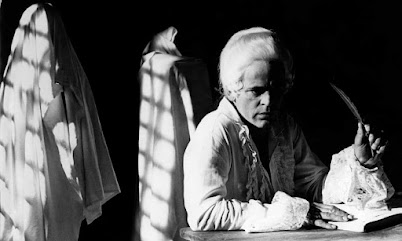
Showing posts with label Woody Allen. Show all posts

Fellini

Aesthetic emotion puts man in a state favorable to the reception of erotic emotion.  Art is the accomplice of love. Take love away and there is no longer art.—Remy de Gourmont
Theoretically, the perfect movie would combine Ford's framing, Ophuls' staging, Fellini's pacing, Visconti's production values and Lubitsch's wit.  But who lines up to see theories? 

We don’t have to ask what the best thing is in any art— everybody knows.  What’s the greatest painting if not the Sistine ceiling?  The greatest sculpture?  The greatest play?  The greatest film?  Many people who bother to consider such things would say 8 ½; and indeed who is the axiomatic director but Fellini?
So let us stand the greatest play and the greatest film side by side: the melancholy Dane and the melancholy Guido.  Eternal high-school kid that I am, I’m always looking for a key to Hamlet.   Maybe this is it!

Like Hamlet, Guido is a new kind of man.  Hamlet Senior is modeled
on Achilles, as heroes had been for millennia, and still are.  “Strength and honor” is the salute in Gladiatorthe values associated with the heroic, and with pop culture.  If you’re not interested in tough guys most cinema is meaningless to you.

The ghost walks in armor, and he expects his son to do the heroic thing, because revenge is the epic motive.  Check your TV Guide.  But Hamlet just isn’t Achilles.  He can’t bring himself to kill Claudius—not that he lacks the murderous impulse.  In neighboring Norway Fortinbras, which means “Strong-arm,” is a replica of Fortinbras Senior.  Hamlet catches sight of Junior marching his army through Denmark to attack the Poles, and is full of admiration; but like all the masks Hamlet tries on, it just ain’t him.  No mask fits Hamlet ("I have that within which passeth show") but he can't represent himself without one.  Who can?  He is, as Harold Bloom says, something new.

Same goes for Guido, and for all of Fellini’s men.  When, in La Dolce Vita, Lex Barker punches Marcello for being out all night with Anita, Paparazzo says, “You’re not going to fight back?”  Marcello shakes his head.  No machismo for him.

Hamlet and 8 ½ both persuade us that the inner life can be portrayed on the stage, on the screen.  We had had to project that innerness onto the gestures and speeches of the actors; these works put it in our face. 

Like Hamlet Guido makes a film within a film, if I may so put it.  


Like Hamlet, he lifts his inner torment above the others, and resorts to irony when he deals with them, and indeed with himself.  Each of them is understood, in his respective world, by no one.

Like Hamlet Guido is haunted by his father, who climbs out of the grave and complains about the accommodations.  “How’s my son doing?” he
asks Guido’s producer, but the producer just shakes his head.

Like Hamlet he has an ambiguously erotic relationship with his mother.  


Like Hamlet's, Guido's dream girl turns out to be "a little bore," as he calls Claudia.

Like Hamlet (indeed like Shakespeare), his reality is shattered and lies there in pieces.  He has no synthetic power but in the vibrancy of each piece.  This seems to me a thread in the velvet of Shakespeare's "voice," so to call it, a note of surrender, a dying fall.

Like Hamlet Guido thinks a hundred thoughts, and none of them are really him.

Like Hamlet he’s a comedian, a monologuist, a clown and, like most clowns, a sad one.  The pair of them are self-pitying smart-asses.
Hamlet is a refined man.  He's been played infinitely differently, and several times by women, as Poldy remarks in Ulysses, but as many ways as we can imagine him, we can't think of him as vulgar.  Why not?  He is crass, dishonest, rash, cruel, murderousthere's hardly a disgrace he doesn't commit.  Ah, but that wit of his.  "So is it, if thou knew'st our purposes."  "I see a cherub that sees them."

Same for Guido, who never commits the vulgarity of action; it's all in his mind.  Fellini wasn’t happy with Marcello as his alter-ego, and made him have his chest waxed to be more refined.  I think he’d have preferred an Alain Delon or an Oskar Werner.  “Oh, Maestro, Marcello again?” say the spirits, mocking him (as when do they not?) in City of Women.

Like Hamlet Guido lives in a world of spirits—in his case Italy, where ancient presences from the pagan panoply that underlies Catholicism roam the earth, and know his thoughts.  "There are more things in heaven and earth, Horatio, than are dreamt of in your philosophy."

Like Hamlet he's blocked by his contradictions.  “And in my heart there was a kind of fighting.”  Guido answers yes and no to every possible question.  “Do you have children?” says the Cardinal.  “Yes, I mean no.”  This too is post-heroic.  The hero is always yes or no, zero or one: only one man comes back from a gunfight.  “Decide, Guido!” his producer shouts as they view the screen tests; “Choose!”  Guido can’t.  He is not the decider. 

At the station he throws away his collaborator’s ruthless critique of his script, then picks it up and reads it again.  This is a scene he stole from Buster Keaton (Leone used it too, at the beginning of Once upon a Time in the West): the train leaves, his mistress hasn’t arrived, he’s relieved and gets up to go, but as it pulls out there she is in white fur trimming.  “Yoohoo!”  He looks around; does anybody see?

Then he takes her back to his room and has her perform his sexual fantasies.  For once he’s a director who knows what he wants.

Like Hamlet, Guido knows the self is not socially acceptable.  They free us from Christianity—that won’t work for either of them.  Hamlet, murderer of men, torturer of women, frees us from sin, negates sin.  It no longer matters.  Yet we have no doubt of his metaphysical validity.  (I don’t want to say “salvation”—Christianity doesn’t work for me either.)  The redeemer as smart-ass.

And what is Guido if not an impotent god?  Both of these men are open-topped.  They communicate directly with—what?

Happiness, Guido says, is being able to tell the truth without hurting anybody.  His sensuality is all that interests him.  He's not a Christian, saints be praised, but he’s Catholic, and confession is part of his style.  The screen tests in 8 ½ are confessions to his wife.  Everything he does is a confession.  When he goes down into the Dante-esque steam room to interview the Cardinal all he can do is confess“Father, I am not happy.”  “You’re not here to be happy,” says the Cardinal with some justice, but then he quotes Origen, the Church Father who castrated himself: “There is no salvation outside the Church.”  And there is Guido, outside the Church.

Ah, he’s down.  But at the end, the uplift!  “What is this flash of joy that’s giving me new life?”  I have mentioned 
elsewhere that the Protestant inclines to schizophrenia, and the Catholic to manic-depression.  Guido’s spirits simply lift, and we have his vision of a latter-day Communion of Saints.

But humility, charity—don’t look for them in Hamlet.  Don’t look for them in Guido.  “He never gives, nor lends, nor trusts,” the feminist judges say of Snaporaz.  Early on Fellini worked under the yoke of Neo-Realism, which he subverted at every opportunity.  Social reality interested him not even slightly, but it was the only game in town. 

In Il Bidone Broderick Crawford plays a con man disguised as a priest.  There’s a touching moment when he’s asked to comfort a wheelchair-bound teenager, who tells a sad story.  He shrugs—at her, at the whole movement: “You don’t need me.  You’re much better off than a lot of other people.”  When he and Richard Basehart are milking a village Basehart smiles at an urchin, a perfect Neo-Realist poster, but “You look like a little devil,” he says.  Devils are what we seem to be in Fellini.  “And the bravest of the devils said ‘I’m going to get into the labyrinth!’” Giulietta tells the kids in Juliet of the Spirits.

Not that he took evil seriously.  When the Fascists fill his father full of castor oil, which in fact was their practice, to humiliate him by making him shit himself, the young Fellini, and the older Fellini, think it’s a big joke.  An American bombing raid forces him and his Roman hosts from their dining tables in the street into an air-raid shelter; but you can meet some good-looking women down there.

“There’s a divinity that shapes our ends,” Snaporaz quotes in City of Women.  I don’t know how deeply the Maestro read in Hamlet—he didn’t like to be thought of as an intellectual.  And Toby Dammit, the Englishman in Rome, gives us just enough of Macbeth’s “Tomorrow and tomorrow” to let us know that he’s a tragic Nordic.   These schizos; if you want to get where you’re going you can’t take your head.
Most of us think Hamlet is Shakespeare’s greatest work, and 8 ½ Fellini’s.  (Thank God for black and white.)  (Thank who?)  Everything else Fellini did is episodic—breaks into episodes that can be eliminated without affecting the story.  This, as Aristotle told us, is bad for business, and relegates those films to what we currently call art-house status.  Only plot sells: not beautiful language, not beautiful shots, not beautiful stars; plot.  Which is to say because, not and then.  The king died and then the queen died, said W.H. Auden, is a story; the king died and then the queen died of grief is a plot.

In his first solo-directed feature The White Sheik Fellini did give us a unified plot: provincial newlyweds come to Rome to meet his family and she gets lost and winds up with a photo-roman hero she's always adored, played by the superb Alberto Sordi.  (Woody Allen took this for one of the strands of To Rome with Love, and has a Sordi look-alike for the star.  So fond was Allen of the piece that, though it’s only a day-long thing, he edits it in with other strands that carry us through weeks, as if they were happening simultaneously.)

Apart from that one, in Fellini’s work, only 8 ½ is all of a piece.

Of course Guido’s Catholic upbringing has repressed him.  Enter Freud.  To clog the intelligence with an idea is un-Shakespearean, so here ends the resemblance to Hamlet, which may be construed as a systematic flushing of ideas.  We enjoy them as we evacuate, but this is nothing to the postpartum levity; Hamlet, like Guido, feels lighter in act five.  Ideas, to change the metaphor, or perhaps not, are fireworks displays, illuminating the terrain for a momentexisting for their own glory, then vanishing.  (I like the Irish-accent pun in Finnegans Wake: “when they were jung and easily freudened.”)  

Hamlet renounces all precedent, but Fellini is a classicist.  The art historian Kenneth Clark said that one of the aspects of classicism is smoothness of transition.  Few films are as smooth as 8 ½. 

Classicism is Fellini's moral touchstone.  At the end of La Dolce Vita Marcello and his cronies invade a friend’s beach house for an orgy, and when the owner returns he is amused, tolerant; but when they start breaking things he throws them out.  He is a balanced man, a classical man, and we meet him again in Satyricon, the aristocrat who, now that everything is falling apart, frees his slaves, sends his children away to safety and commits suicide with his wife.  Do with the house now what you want.  Does Fellini approve of Marcello's orgy, of Encolpio's ambisexualism, of Casanova's exploits?  Yes and no.

Dante inspires 8 ½ as Piranese, the ultimate designer of labyrinths, does City of Women, and the labyrinth is Fellini's image of human existenceIn the castle maze of La Dolce Vita Marcello and Anouk Aimée make contact by voice through an acoustic whatsit and exchange words of love while she makes it with another guy.  In Satyricon's Cretan-style labyrinth the murderous Minotaur turns out to be a joke.  Like Icarus Guido wants to fly, Toby Dammit wants to fly, Snaporaz wants to fly.

People who argue that Shakespeare wasn't pornographic cannot have read Venus and Adonis.  Man delights not me; no, nor Woman neither; though by your smiling you seeme to say so.”  Sounds like he's been there, though.

Fellini's sensuality is all-consuming, and in this he and his compagni are fixed entities.  Change! says Snaporaz to the feminists; Into what?  A  journalist shouts to Guido, “Is pornography the most intense form of entertainment?”  Sylva Koscina's performance as the sexy sister in Juliet of the Spirits removes, for the moment, doubt.
Hamlet by contrast is a master of change.  The purity of total change is hypnotic in him, as long as it isn’t moral.  

What a pair of rapscallions!

Of course art is not moral.  Morality is intention.  In Roman Catholic sin-ology the intention makes or unmakes the sin.  In art intention counts for nothing.  You make a film, Jean Renoir said, to find out what it will look like.  In Hollywood movies intention counts for everything.

The only other filmmaker we can compare to Fellini is Luis Bunuel, and both are Freud guys.  For both it comes down to the sexual impulse.  Which, sure.  Both do fantasy and dream, and blur their borders with reality.

Bunuel is a great poet.  In The Discreet Charm of the Bourgeoisie a boy’s dead mother calls to him from the closet where her clothes sway.  As a kid I never had such a strong sense of my mother’s presence as when I went to her closet, opened the door and smelt the perfume.

Bunuel made for me what is the ultimate horror film.  Most people find The Phantom of Liberty funny.  (This is the one where people sit on toilets at the dinner table, and escape to the bathroom to eat.)  But he so accurately gets the entrapment of dreaming, which leads us by association from this to that in a way entirely beyond our control, that it frightens me.

But superb as he is, he is as cold as Velázquez.  Fellini, as I don’t have to tell you, is warm warm warm.  He mocks himself for his nostalgia, but it’s no less compelling for that. 


Guido is tender.  Hamlet is sensitive, but he’s not tender.  Falstaff is tender.  Lear, at the end, is tender.  Not Hamlet.  (“Think yourself a baby That you have ta'en these tenders for true pay, Which are not sterling.”) 

To Giulietta’s dismay Federico was active in the field of love, but he didn’t see himself as a man of action: “I am the only one I know,” he once said, “who can admit that it’s all fantasy.”  The man of action he satirized in Casanova.
To his fantasies Fellini gave the classical form of goddess-worship.  The labyrinth is where you don’t know what’s going on.  As the Goddess tells Roberto Benigni’s holy fool in Fellini’s last film, The Voice of the Moon, he’s not supposed to know what’s going on.  “You do not have to understand.  Woe to him who understands,” she says, and she has the last word.  I don't know if that would satisfy Hamlet, but he does, in the fifth act, seem at peace with the divinity who directs him.
The holy fool is a figure Fellini had cultivated in the Neo-Realist days, possibly because Giulietta—indomitable, wide-eyed with wonder—was so adept at playing it.  Does Zampanò abuse her?  All people have value, Il Matto tells her, one holy fool to another.

When Fellini lost interest in his fantasies his films, for me, flattened out.  We want the refugees saved in And the Ship Sails On, but I can’t sit through it, or Ginger and Fred, or Intervista, not again anyway.  In The Voice of the Moon he returns to the holy fool, and it does have moments of charm, but as Rabelais said, “Now my innocence begins to weigh me down.”

Then again, at the end of his life Shakespeare is supposed to have collaborated on Henry VIII.  I can’t get through that either.

I know that when I discuss these things I’ll lose them, and that’s partly why I do it, to exorcise them and free my own voice.

At his best Fellini was the most exuberant, the most generous, the most gorgeous of filmmakers.  And where would we be without gorgeousness?

Bob, what a wonderful piece! Thank you. I think Fellini would have chuckled at it, in a good way.  
Thanks again,
Paul Mazursky

Comments? Right here.

Robert MacLean is a bad poet and an independent filmmaker. His The Light Touch is on Amazon PrimeTubi and Scanbox, and his 7-minute comedy is an out-loud laugh. He is also a screamingly funny novelist, a playwright, a blogger, a YouTuber, a reviewer of films, a literary critic, and a stand-up comic poet. Born Toronto, PhD McGill, taught at Canadian universities, too cold, live Greece, Irish citizen. Committed to making movies that don't matter. No brains, but an intellectual snob.

Frankly, I forgive myself.

In Bed with the Girls

The Light Touch on Amazon Prime

Film reviews: Hillbilly Elegy

The Natural Wish to Be Robert MacLean


Vladimir Nabokov and Twelve-Year-Old Girls

If it weren’t for Lolita we might never have heard of Nabokov, which would be a huge loss. Success is so often a matter of scandal.
 

I like P.G. Wodehouse best; no one else gets us so high. But when I descend into actual literature—an abrasive experience for my sensitive soul, but one that has allowed me to fiddle away my time unproductively—I cannot but acknowledge that the five great novels of the twentieth century are Ulysses, A la recherche, Gatsby, Under the Volcano and Lolita.

Nabokov's images fill me with awe; his phrases are tiny masterpieces; his sentences, galleries with their own exquisite shapes. But even in his most gorgeous stories he can be something of a stuffed shirt:

The snag with Vladimir Nabokov was
A dyspepsia almost as noisome as Waugh's.
Life offered neither
A very long breather
From constant unbearable irks.
Now I've wrung my enjoyment from both of these men
I need not be exposed to them ever again
But I suffer the scourge
Of a lingering urge
To pour Eno all over their works!

 
What gives Lolita that extra thing is the confrontation between a cultured European and the American vulgarity embodied by Lolita, with whom he is desperately in love. Then too, one cannot but feel that it's a portrait of Nabokov’s own passion. And passion delivers.

It’s shameless of me to say this—I know nothing of this man’s inner life—but  lust for young girls does emerge elsewhere in his work, and in Lolita he contributed the word “nymphet” to the English language. It's my intuition that his stuffed-shirtism, so at home after all in the 1950s, is a firewall against an unseemly urge. In one of his essays he opines that if the criminal could only write about the crime he wouldn’t have to commit it. Like Dostoyevsky, Lewis Carroll and J. D. Salinger, he converted the obsession into literature. Balthus did it in paint:


But no psychology can touch bottom, and VN would have agreed:

Nabokov was annoyed
By Freud,
Considered Eliot
Beneath yelling at
And Dali
Too far gone to rally;
Waugh regarded Eliot
As brelliot
But thought Picasso
Was an asso.


Nevertheless I will dare to say that his orientation was not a whim. Many people, for example, can be gay on a whim, myself included; but there are also people who can’t imagine any other way of doing it. The conclusion forces itself upon me that sexual preferences are hardwired. One might be grateful if one’s wiring isn't too inconvenient, though there’s nothing terribly convenient about heterosexuality; it can be as big a p. in the a. as the other thing.

It’s OK to like little boys if you’re a king, like Henry II or James I or William III (of William and Mary); or if you’re an aristocrat, like the Earl of Rochester (the Johnny Depp film about him was dreary, so unlike the merry Earl) or Lord Byron; or if you’re a famous novelist like Thomas Mann, or a celebrity poet like W.H. Auden:

Said the Queen to the King, we do frown on
Your choosing our page to go down on
When you meet on the stairs—
And it does give him airs
If you
will do the job with your crown on!


But if you’re an average Joe they’ll throw you in the can with gorillas who are as repelled by the vice as church-goers, and will pick on you.

Ditto for little girls: in the literary world you’re somewhat protected. When he publishes his poems in a book Leonard Cohen can say, “The fifteen-year-old girls I wanted when I was fifteen, I have them now. I advise you all to become rich and famous.” But in the popular eye, like Polanski or Woody Allen, you have to watch it. Woody's mentor in Love and Death tells him, “I have come to the conclusion that the best thing is blonde twelve-year-old girls. Two of them, whenever possible.”

Had Nabokov proceeded to his PhD,
Would he have to shake his polymathic rattles at me?
Had Woody Allen only finished his BA,
Where'd his undergradjut exercises be today?


In Lolita Humbert makes his own list: “Marriage and cohabitation before the age of puberty are still not uncommon in certain East Indian provinces. Lepcha old men of eighty copulate with girls of eight, and nobody minds. After all, Dante fell madly in love with Beatrice when she was nine, a sparkling girleen, painted and lovely, and bejeweled, in a crimson frock, and this was in 1274, in Florence, at a private feast in the merry month of May. And when Petrarch fell madly in love with his Laureen, she was a fair-haired nymphet of twelve…”

He might have mentioned Juliet, who was thirteen when she married Romeo, Edgar Poe, who married his cousin when she was thirteen, and that other southerner Jerry Lee Lewis, who married his cousin of thirteen
—though Nabokov may not have been following Jerry Lee's career. (If a boy from Alabama marries a girl from Louisiana, are they still cousins?)

Poe
Is slow.
The diction is inflated
And the angst is overrated.


Indeed, one thinks of Margaret Mead and Alfred Kinsey, who tell us that there’s nothing inherently wrong with sex with the young, that it’s the adult hysteria that does the damage.

One thinks also of the pedophile priests in the Catholic Church—of the sheer number of them! Were Mead and Kinsey inspecting us as a tribe they might conclude that it was the norm.

It is a convention in our time to go on TV and say you were abused as a child. If you’re a politician in the Bible Belt, you oppose same-sex marriage and you get caught using a male escort service, you go on TV and say you were abused as a child. The etiology may be dubious, but it works with the public. 


In The Girl with the Dragon Tattoo, which I've just seen, the heroine was abused as a child, the victim was abused as a child, the villain was abused as a child—it explains everything!

As for my own case (I can hear you asking), I’m a narcissist with a taste for older women. Now that I’ve reached a certain age there are no older women, and the guy in the mirror isn’t looking that good. But one presses on. (See In Praise of Older Women.)

Ours is a period of neo-Victorianism. Freud, whatever his ultimate merits, freed us, not only from nineteenth-century prudishness, but from the Christian prohibition that dates from Saint Paul. Freud’s influence took wide hold in the fifties and sixties, just as the birth-control pill was freeing us from the anxiety of getting “caught,” as people used to say, and penicillin was freeing us from the horrors of syphilis and gonorrhea. Oh, we had much too good a time! Then herpes and AIDS, stark parallels to the old scourges, pushed us back toward something more sentimental.


Lolita was written in the early fifties, another dryness of atmosphere, and by his own account Nabokov’s wife stopped him from burning the manuscript. Here is Humbert hating himself even as he possesses his dream:

I recall certain moments, let us call them icebergs in paradise, when after having had my fill of her
after  fabulous, insane exertions that left me limp and azure-barred—I would gather her in my arms with, at last, a mute moan of human tenderness (her skin glistening in the neon light coming from the paved court through the slits in the blind, her soot-black lashes matted, her grave gray eyes more vacant than ever—for all the world a little patient still in the confusion of a drug after a major operation)—and the tenderness would deepen to shame and despair, and I would lull and rock my lone light Lolita in my marble arms, and moan in her warm hair, and caress her at random and mutely ask her blessing, and at the peak of this human agonized selfless tenderness (with my soul actually hanging around her naked body and ready to repent), all at once, ironically, horribly, lust would swell again—and "oh, no," Lolita would say with a sigh to heaven, and the next moment the tenderness and the azure—all would be shattered.

This, Nabokov insists, is not his remorse but Humbert's: "He cares, I do not. I do not give a damn for public morals, in America or elsewhere." 


Harold Bloom introduces his study of Shakespeare, whom he regards as a god (and in his Gnostic parlance he means it), by arguing that Shakespeare was anti-Semitic, that we’ve been misreading The Merchant of Venice for four hundred years. “There’s a price for loving Shakespeare,” he says. Arthur Koestler once remarked that if he threw out his anti-Semitic books he’d be deprived of half his library. It's rather sad. In Moby Dick Ishmael, whose lover is a South-Sea islander, regards the whale's whiteness as the same mark of superiority that gives "the white man ideal mastership over every dusky tribe." What shall we do with these texts?

Dostoyevsky was an anti-Semitic child-rapist and a hypocrite, who lied even to himself. The only erotic moment in Crime and Punishment is when ten-year-old Polina, step-sister to the Hallmark-Card heroine, comes down some stairs and kisses Raskalnikov. But any such enjoyment is pinned on the child-raping villain of the piece, whom we are encouraged to hate. Dostoyevsky himself was a loathsome man; one wouldn’t have wanted to meet him. But he is the greatest novelist in human memory, and there is no book as passionate, as thrilling or as psychologically intimate as Crime and Punishment.


“The great artists of the world are never Puritans,” said H.L. Mencken, “and seldom even ordinarily respectable. No virtuous man—that is, virtuous in the Y.M.C.A. sense—has ever painted a picture worth looking at, or written a symphony worth hearing, or a book worth reading.”

Martin Amis, a writer of astounding mediocrity, is a better embodiment of our time. He is the son of Kingsley Amis, whose first novel was a hit, after which he collapsed into a lower-middle-class philistinism that dismayed his readers
—but there he was, the author of Lucky Jim. And there was Martin—and he was a writer too!sustaining his career on the same book.

Kingsley Amis
Is justly famous,
And his first book scored it!
But it’s one thing to attract attention, and another to reward it.


When Junior speaks of Nabokov he says, “you would need to venture to the very fringes of literature—Lewis Carroll, William Burroughs, the Marquis de Sade—to find an equivalent emphasis: an emphasis on activities we rightly and eternally hold to be unforgivable.”

Good little man. Straight from the Y.

And English literature—we must have the courage to face it—is dead.


Robert MacLean is an independent filmmaker. His The Light Touch is on Amazon PrimeTubi and Scanbox, and his 7-minute comedy is an out-loud laugh. He is also a novelist, a playwright, a blogger, a YouTuber, a film reviewer, a literary critic, and a stand-up comic poet. Born Toronto, PhD McGill, taught at Canadian universities, too cold, live Greece, Irish citizen. No brains but an intellectual snob.


I was beastly but never coarse. A high-class sort of heel.

The Light Touch on Amazon Prime

The Natural Wish to Be Robert MacLean


The Marquis de Sade, Father of Modern France


De Sade
Might have been perfectly glad
To have had as his hassock
Masoch.
I love France.

And I love Paris. It doesn’t matter how Disneyfied it gets; it remains the world’s capital, the measure of all cities, and not just for me. In the Middle East they call Beirut “the Paris of the Mediterranean.” They used to, anyway. In Asia Shanghai is
the Paris of the East. In America Montreal is “the Paris of the North.” “When good Americans die,” as Oscar said, “they go to Paris.” And so do bad Irishmen: Oscar is buried there.

And I love the French. Sort of. Their style, their indolence, their cuisine…so much about them endears them to one. But they are not, it must be admitted, sweet-natured. Not warm. They are, to use their own phrase, le peuple le plus désagréable du monde, même entre eux—the snarkiest people in the world, even to each other.

How did this happen? Were they always like that? Is it, as so much is these days, genetic? (See My Racial Profile.) If not, what, or who, could be the cultural antecedent of this manner?

Is it Rabelais, father of the long lunch? “Frugality,” he said, “is for the vulgar.”
My kind of guy. “It is godlike to lend, but to owe is a heroic virtue.”
When he came to die he left this will: “I have nothing; I owe much. I leave the rest to the poor.”

No, there’s too much generosity of spirit there. It can’t be him.

Is it Montaigne, whose suave self-contemplation supplanted the wisdom of the ancients? Too mild. Too tolerant. And he was so deeply inhaled by Shakespeare that we tend to think of him as an Englishman.

Molière, then? That comic genius? No no no, too free of heart. Too funny. (Note though the remark in his Dom Juan that a peasant girl is at a disadvantage compared to a Parisienne, who need only adjust her coiffure to sharpen her allure. Ah, Paris!)


Voltaire? The wit, the very soul of the Enlightenment? "The trouble with honest people is that they're cowards." Hey! Almost! But no, he's simply too polite.

It cannot have been Rousseau, who loved nature and found it morally good. De Sade quashed that: “Nature averse to crime? I tell you that nature lives and breathes by it, hungers at all her pores for bloodshed, yearns with all her heart for the furtherance of cruelty!”

So it’s not Rousseau. No, it’s the Marquis himself. With him something enters French culture that had not been there before. Suzanne in Diderot’s The Nun suffers, it’s true, including erotic molestation by the Mother Superior, but she is rescued, and never submits.  And Rétif de la Bretonne (he and de Sade hated one another) gave his name to the shoe fetish, known now as retifisme.
We like these on you, girls. We love to see you helpless.

But only the Marquis gives us the whole deal: "There is no more lively sensation than that of pain; its impressions are certain and dependable—they never deceive as may those of the pleasure women perpetually feign and almost never experience." Not a bad psychologist. Cheer up, guys.

After him we get a new cruelty in French culture. I don’t mean Balzac and his books for twelve-year-olds, his gosh-isn’t-it-great manner; or even the torture that is axiomatic in Hugo’s novels.

I don’t just mean Delacroix and his orgiastic scenes of rape and slaughter—

—or the enthusiasm for women of color shown by Baudelaire, Gauguin and Rimbaud, meant to dramatize their, how shall I say, focus, not to say their dominance.

I mean the merciless exposure to which her author subjects Emma Bovary. She, a fool, and her husband, a fool—a doctor, no less, who bungles an operation on his clubfooted patient and causes his leg to be amputated—scurry like bugs under Flaubert’s microscope, his heart as neutral as glass. As Erich Auerbach said, their “world consists of pure stupidity.”  Even the title is a sarcasm, “Madame Bovary,” as if the poor girl were the lady she longs to be. 


Flaubert
Shaved his short hair
And reclined in the raw:
“Madame Bovary, c’est mwaw.”


And what is there, outside of the Marquis, to match her suicide, writhing in agony for days with arsenic in her belly? Anna got it over faster by throwing herself under train wheels; what a moment that must have been. Bad women must be punished, sure, I understand that, but for Emma it’s drawn out to what can only be described as sadistic length.

Here starts an entire mode of narrative. Flaubert’s protégé de Maupassant despises his characters, jeers at them. I love Proust as much as you do, but I want to be at eye-level with Swann; of course he’s a chump, who isn’t, but I don’t want always to be scoffing at him, always to be looking down at him through the Flaubertian lens. 


Zola
Has the flaw
That the earthy passages that should make me drool

Just make me want to fish my jeans out of his pool.

Emma has many heirs, like Séverine in Belle de Jour, also married to a doctor. We may consider Bunuel because he regarded Paris as the capital of Spain, even before Franco. Indeed the Marquis makes personal appearances in two of his films, and Severine gets the whipping she dreams of. But not the life.

Torture had always been used for political purposes, as we use it now. The Church used it for religious purposes, but then religion is politics (I propose this as a definition). De Sade's innovation is to have used it for sexual purposes.

He is not spooked by age; his ramrod hero the Duc de Blangis is fifty. Nor is he just a master, like Nietszche; he submits to the whip himself, and Blangis regularly has himself sodomized.

There is no superego in de Sade, no conscience, no heart to be appealed to; this is his fascination and his insolence, and makes him royally dangerous. And, yes, the heart is tricky; it believes anything.

On the other hand he identifies himself with nature, rather like Byron with the raging storm—magnificent, but faintly disappointing; why identify with anything? He supposes his sex drive to be larger than ours—how dare he! And his assumption that tenderness is cowardice doesn't fit quite comfortably, not that he cares for comfort.

But his real sin, if I may so put it, is his seriousness. Libertinage and perversion are fine old traditions, but Casanova and the Earl of Rochester laugh at themselves. You won't find many laughs in the Marquis. He is a man of commitment. And then, once the orgasm is over, we're left standing around in our leathers.

The Marquis was in many ways the pride of his species;
I just hope he flossed after gobbling those feces.


It is almost precious that he is vulnerable to jealousy: "She who, either in seeking base revenge or, what can be even more sordid, out of a gross and vulgar urge to satisfy her carnal appetites, gives herself wantonly to a footman—"  But let us draw a veil over the rest of this discourse.

Quite apart from torture, he—more than Freud, before Freud—made sex the content of every gesture. Like Freud he advised resisting the superego (though he wants virtue to exist, or we'll miss the pleasure of violating it), and Miller and Lawrence regarded him as the real liberator. He sponsored the passionate commitment to the carnal that we have in Genet, Duras and Robbe-Grillet. In what other country are there erotic writers of such stature?

A journalist at a press conference accused President Mitterand of having, not only a mistress, but a daughter by her. "Et puis?" he shrugged. "So?" End of story; not even a follow-up. In America he'd have had to go on TV and say he was abused as a child, not that it would halt the impeachment.

One pictures Strauss-Kahn leaping nude from single bed to single bed and throwing himself on a serving wench. (Did he, however, force his shah into an unwelcoming oral cavity? The portcullis comes down and then where are you?) It’s all the Marquis, my darlings.

“Orgasm and sarcasm,” as Woody Allen sums up the French, and they're related: if the former is your reality, how much patience do you have with anything beyond the enticements of coiffure and couture?

The French critic Roland Barthes said that “teasing is a sadistic passion,” and this, comic writer that I am, draws me to him (de Sade, not Barthes). I’ve been thrown out of bars for teasing. Kicked out of bed. Made to stand in corners. Can’t resist. 


I used to be a semiologist
But now I’m not Saussure.


It can be embarrassing for the Anglo-trained male to realize that French women, I don't hesitate to generalize, expect you to enjoy hurting them. They don't enjoy it themselves, necessarily, but they expect you to. Gosh. They really are different people, and they regard us, with some justice, as children.

The Marquis could never have been an American. Manson's efforts achieved for him only a kind of psychiatric sainthood. The psychopath is a stock American figure, at least from Ahab on, and few Hollywood movies are without one. But de Sade was in the Bastille so his family could guard its reputation, and in the Charenton asylum so the Revolution could distance itself from his writings. He wasn’t a psycho.

I often think that Shakespeare lies behind the Anglo-Saxon success, just as Homer lay behind the Graeco-Roman one. Alexander slept with the Iliad beside his bed; he wanted to be Achilles; Caesar wanted to be Alexander. [Hamlet declined to be Achilles; there are no heroes in Shakespeare unless they're more or less assholes. De Sade, be it noted, delights in violating every law of nobility he can think of.] The Church, though it governed Europe for a thousand years, thrust its rule into heretical times bolstered by Dante. France has the Marquis. 
One overhears, in a Paris café (this actually happened), two waiters discussing whether an acquaintance is Cartesian or Pascallian: does he favor doubt or faith? All French, the French feel, are either one or the other, and we might rush to conclude that here are their real antecedents. 

Sartre
Let an enormous fartre
And sighed, "Descartes be damned.
I stink, therefore I am."


But regard the waiter as he separates himself from his confrere to “serve” you, the subtle brusqueness with which he lets you know you are intruding on his time, the culpable helplessness with which you submit while he removes, with balletic crispness, whatever is on your table, and asks you with a “Oui, m’sieur?” what you think you might want.

Do not offer him your French to sneer at. Only raise your eyes to meet his, gleaming down at you with casual malice, and you will find yourself face to face, there can be no doubt, with the Marquis.

Robert MacLean is a bad poet and an independent filmmaker. His recent The Light Touch is on Amazon PrimeTubi and Scanbox, and his 7-minute comedy is an out-loud laugh. He is also a novelist, a playwright, a blogger, a YouTuber, a film reviewer, a literary critic, and a stand-up comic poet. Born Toronto, PhD McGill, taught at Canadian universities, too cold, live Greece, Irish citizen. No brains, but an intellectual snob.

An elegant woman is a woman who despises you and has no hair under her arms.”—Salvador Dalí

The Light Touch on Amazon Prime

The Natural Wish to Be Robert MacLean