Hitch and Cary: A Study in Charm

"Even Cary Grant isn’t Cary Grant."—Cary Grant
Grant and Hitchcock—not exactly identical twins, but the same kind of guy, really. They had charm. "Thin people," Jackie Gleason said, "are beautiful, but fat people are adorable." Hitchcock seems to have agreed. "In England," he said when he got to Hollywood, "everybody looks like this." He does his de rigueur cameo in Lifeboat, with its confined setting, in a weight-reducing ad. He's the one on the left. Neither of these blubber-bellies ever got serious about dieting. 
As the television host of Alfred Hitchcock Presents he came into our living rooms every Sunday night with perfect British aplomb,  the merry mock-lugubrious image of sophistication. "Good evening," he always began.
"Television has brought murder back into the home," he said, "where it belongs." Like Grant he was a symbol, in America, of debonair elegance. Not your average food-on-the-teeth Brit.
Back home, though, he was lower-class. When he worked in England, even as late as Stage Fright in 1950, his actors complained that they couldn’t understand him through his Cockney accent. And notice, when he goes into the houses of the rich, how the camera always stays downstairs looking up at a world into which it dare not intrude. Strangers on a Train and Marnie fly to mind; here's Rebecca:
And Grant, real name Archie Leach, was, class-wise, Hitchcock's Bristol equivalent. He worried all his life that he lacked the background for what he was supposed to be. 
Both, despite their enormous success, were always slightly out of place in the US. Hitchcock's American films, though his obsession with detail is inspiring, never seem to me to be quite American: the people are too mild, too mannerly—too British. Even his salesclerks are polite—chatty without being intrusive. There is never the undercurrent of physical threat that haunts American movies, and indeed American life. Murder and psychopathology are there all right but they're disguised, as they are in Agatha Christie, not, as in the United States, a matter of style. 
Same goes for Grant: he was never all the way American. Imagine him getting angry. Impossible. Anger is the opposite of charm. Anger says things aren't going your way. Everything went his way, except when it didn't, in which case he ran like hell. Scarcely an American hero.
Part fool, part coward, is what he was, and here, I am at one with him. Punch somebody? No no no. When it comes to a fight, as in Charadehe allows the George-Kennedy giant to defeat himself, then lectures him on loving thy neighborthough that wasn't entirely his policy. Fuck you, I'm Cary Grant, is more like it.
An article in The Atlantic, "The Rise and Fall of Charm in American Men," centers of course on Grant, but then shifts the focus to Orson Welles and James Garnerwell, all right—but leaves Fred Astaire out entirely! And in predictable Puritan fashion it pronounces a negative judgement on charm: it is "amoral," unAmerican and to be watched out for. Thank God it's gone. Grant was gay.

And indeed, what would he do in a film by Crapola or Scorsleazy, advertisements, both, that America has run out of decency. It seems clear what he would not do, but what would he do? (For more on this see Italian-American Filmmakers.)

Which brings us to the question of the psychopath. Hitchcock had dealt with psychopaths in his British films, so I don’t know whether it was by insight or by predilection that he so consistently exploited this theme in Hollywood. As a Frenchman in one of my fantasies says, "The psychopath is an American tradition since Captain Ahab and poor Mr. Poe. One daren’t make a film without one. Such people are the norm here—corporate conventioneers, fast food waiters, religious fanatics—even the hotel clerks glow with sinister joy.  Observe yourselves in television audiences. You are all quite mad!"
A header in the New York Times: "Once I got pregnant I had to abandon the drugs that made me stable enough to want to be become a mother in the first place." Everybody's a psychopath. When Martin McDonagh came to make an American film he wrote for himself Seven Psychopaths, which, as a strategy, couldn't miss.

In Suspicion Grant plays the psychopath, and Hitchcock complained to Francois Truffaut (a man of extraordinary dullness) that he couldn’t end the film the way he wanted to because you can’t make Cary Grant a murderer.
He also told Truffaut that, although he had only made one overt comedy, all of his films were more or less comic. Perhaps this explains why my favorite Hitchcock films are the Cary Grant onesespecially To Catch a Thief and North by Northwest, which to me are romantic comedies—so much so that I’m inclined to regard Grant as their real auteur.
Now, please, Hitchcock is a master, for many people the master of cinema, an inventor not just of images—the chase among the umbrellas in Foreign Correspondent, the tennis-game in Strangers on a Train, all faces going back and forth with the ball except the psychopath’s—but of sounds: he was the first to experiment with electronic synthesis in The Birds. (And let's mention casting—George Sanders as a used-car salesman in Rebecca: inspired!)
But more than that he could give you the feel of a relationship. James Agee remarked of Notorious that Hitchcock was "as good at domestic psychology as at thrillers, and many times he makes a moment in a party, or a lovers' quarrel, or a mere interior shrewdly exciting in ways that few people in films seem to know." 

One thinks of his silent The Lodger, in which the lovers are endeared to us by their habit of hovering in a restaurant until they can pounce on their favorite table; and of Marnie (where the psychopath, for the first time since Rebecca, is a woman), when Sean Connery’s character tells her that, although marriages are said to succeed or fail in bed, they’re really about control of the bathroom.
And—this I love—Hitchcock was impatient with Method acting and the Actors Studiowhich made Brando the punk and De Niro the lunk high priests of seriousness. ("When you hear the phrase a good acting job," says Toby, "it usually means a depressing movie.") As a filmmaker in Europe I always forget what I’m going to confront when I work with an American actor—back story, motivation and ceterathe whole spiritual exercise.  (See The "Character Arc".) 

"When an actor comes to me and wants to discuss his character," said Hitchcock, "I say, It's in the script. If he says, But what's my motivation? I say, Your salary." All he wanted Paul Newman to do was hold still for the camera, but no, he was too involved in the part. ("Never do eating scenes with Method actors," said Bogart, "they spit all over you.") "I don't feel like that, I don't think I can give you that kind of emotion," Ingrid Bergman told him. "Ingrid," said Hitch, "fake it."
When an actress asked him which of her profiles was better he said, "My dear, you're sitting on your best profile."
His attitude to character is clearest in Psycho: if you kill the heroine in the first act you'd better replace her—and yes, here comes her look-alike sister, thrown so together with the hero that she's set up to be his new squeeze. It's the kind of mix 'n' match you get in A Midsummer Night's Dream and Così fan tutte—whichever partner the dance gives you. But the Puritan must think one self, one love, one moral quest, and God help you if you enjoy it. I'm not a Christian but I did like the way Pope Francis ended his first speech: "Have a good lunch."
Nor does Hitch care much about connections. Plot, yes, his plots are tight, but he moves us from scene to scene with a beautiful arrogance. In To Catch a Thief policemen stalk Grant's character through a market (where, in Cannes? Nice? Monte Carlo? Hitchcock, usually so careful about place, uses all of them to compose a Riviera town) at an ever faster pace until he upsets a flower stall and the owner snags him by the sweater and won't let him go. "Madame! S'il vous plaît, Madame!" What happens—do the cops arrest him? Do they take him to the station? Do they question him? Hitchcock doesn't care, and neither do we: cut to lunch on the terrace overlooking the village on the sea, with not even the mention of a resolution of the previous scene. 

Or did he care? Did he, as most filmmakers would, agonize in the editing room over some dull takes he didn't dare slow the film down with? Did he perhaps realize that, like Fellini but in his unique way, he was a master of gorgeousness? We are accustomed to thinking of his art as severe but in that film, as in many others, spectacle was all that interested him.

On the other hand there’s a lot of b.s. about Hitchcock, to some of which he contributed himself. He said things like "If it's a good movie, the sound could go off and the audience would still have a perfectly clear idea of what was going on," and "When the screenplay has been written and the dialogue has been added, we're ready to shoot." Balls. Nobody has committed more bla-bla than Hitchcock. Psycho has three exciting, nay, emotionally scarring scenes, and an hour and a half of yack-yack.
A curious thing happened to this draftsman-cum-storyboarder: long about 1949 (though it might have come as early as Lifeboat) he fell in love with the theatre, and started directing movies as if they were plays. RopeStage FrightRear WindowThe Trouble with Harry—these could all be performed on the stage, and that’s the way he shot them. Dial M for Murder has one exciting visual scene, the scissors in the back; otherwise it’s all dialogue in rooms. And Under Capricorn—oh, God! "Always make the audience suffer as much as possible," he said. Uh-huh.
In the Grant films the problem disappears—perhaps not so much with Notorious, which, as Cary told Peter Bogdanovich, "Hitch threw to Ingrid." But in To Catch a Thief and North by Northwest we’re in the world of Cary Grant comedies and buoyed by the Grant charm, which never requires excessive dialogue.
He's not my favorite actor, I’m not saying that. I prefer the Boyer-Irene Dunne version of An Affair to Remember. (I prefer the Irene Dunne version of anything.) And, here’s an irony, Grant wasn’t as famous as Hitchcock. To quote the above Frenchman, "The very first rank of fame is to be known by your nickname, like Liz and Bogie and Di and Satchmo. The second is to be known by your initials—mainly for American presidents, but Brigitte was BB, which means in French baby, and Marilyn in the headlines became MMM. Then come the first names, Sophia, Marcello, Frank, and fourth are the last names, Garbo and Gable. And fifth…." Well, Cary Grant. Hitch’s nickname was a company-town secret until it got out, but it got out.
Let's tie this up with Charade, the best film Hitchcock never made. Stanley Donen, he of Singin’ in the Rain and Two for the Road, made it instead. It’s got Grant (hoarse at fifty-nine—why do actors seem to age so quickly?); it’s got the darling Audrey, clearly crazy about him and at her breathiest ("I’m not hungry at all any more, isn’t it marvelous!"); it’s got a score by Henry Mancini, one of the Magnificent Seven (Louis, Cole, Django, Stéphane, Henry, Nino and Miles); it's got Paris, and some nice digs at the French; it's got charm from every possible direction; and it’s got warmth, which you’ll look hard for in Hitchcock.
But it couldn't have happened without him. 

Short for time?
Getcha there fast.

Robert MacLean is a bad poet and an independent filmmaker. His The Light Touch is on Amazon PrimeTubi and Scanbox, and his 7-minute comedy is an out-loud laugh. He is also a screamingly funny novelist, a playwright, a blogger, a YouTuber, a reviewer of films, a literary critic, and a stand-up comic poet. Born Toronto, PhD McGill, taught at Canadian universities, too cold, lives Greece, Irish citizen. Committed to making movies that don't matter. No brains, but an intellectual snob.


Fellini

Aesthetic emotion puts man in a state favorable to the reception of erotic emotion.  Art is the accomplice of love. Take love away and there is no longer art.—Remy de Gourmont
Theoretically, the perfect movie would combine Ford's framing, Ophuls' staging, Fellini's pacing, Visconti's production values and Lubitsch's wit.  But who lines up to see theories? 

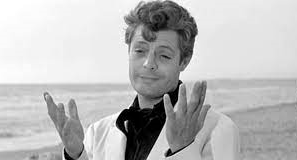
We don’t have to ask what the best thing is in any art— everybody knows.  What’s the greatest painting if not the Sistine ceiling?  The greatest sculpture?  The greatest play?  The greatest film?  Many people who bother to consider such things would say 8 ½; and indeed who is the axiomatic director but Fellini?
So let us stand the greatest play and the greatest film side by side: the melancholy Dane and the melancholy Guido.  Eternal high-school kid that I am, I’m always looking for a key to Hamlet.   Maybe this is it!

Like Hamlet, Guido is a new kind of man.  Hamlet Senior is modeled
on Achilles, as heroes had been for millennia, and still are.  “Strength and honor” is the salute in Gladiatorthe values associated with the heroic, and with pop culture.  If you’re not interested in tough guys most cinema is meaningless to you.

The ghost walks in armor, and he expects his son to do the heroic thing, because revenge is the epic motive.  Check your TV Guide.  But Hamlet just isn’t Achilles.  He can’t bring himself to kill Claudius—not that he lacks the murderous impulse.  In neighboring Norway Fortinbras, which means “Strong-arm,” is a replica of Fortinbras Senior.  Hamlet catches sight of Junior marching his army through Denmark to attack the Poles, and is full of admiration; but like all the masks Hamlet tries on, it just ain’t him.  No mask fits Hamlet ("I have that within which passeth show") but he can't represent himself without one.  Who can?  He is, as Harold Bloom says, something new.

Same goes for Guido, and for all of Fellini’s men.  When, in La Dolce Vita, Lex Barker punches Marcello for being out all night with Anita, Paparazzo says, “You’re not going to fight back?”  Marcello shakes his head.  No machismo for him.

Hamlet and 8 ½ both persuade us that the inner life can be portrayed on the stage, on the screen.  We had had to project that innerness onto the gestures and speeches of the actors; these works put it in our face. 

Like Hamlet Guido makes a film within a film, if I may so put it.  


Like Hamlet, he lifts his inner torment above the others, and resorts to irony when he deals with them, and indeed with himself.  Each of them is understood, in his respective world, by no one.

Like Hamlet Guido is haunted by his father, who climbs out of the grave and complains about the accommodations.  “How’s my son doing?” he
asks Guido’s producer, but the producer just shakes his head.

Like Hamlet he has an ambiguously erotic relationship with his mother.  


Like Hamlet's, Guido's dream girl turns out to be "a little bore," as he calls Claudia.

Like Hamlet (indeed like Shakespeare), his reality is shattered and lies there in pieces.  He has no synthetic power but in the vibrancy of each piece.  This seems to me a thread in the velvet of Shakespeare's "voice," so to call it, a note of surrender, a dying fall.

Like Hamlet Guido thinks a hundred thoughts, and none of them are really him.

Like Hamlet he’s a comedian, a monologuist, a clown and, like most clowns, a sad one.  The pair of them are self-pitying smart-asses.
Hamlet is a refined man.  He's been played infinitely differently, and several times by women, as Poldy remarks in Ulysses, but as many ways as we can imagine him, we can't think of him as vulgar.  Why not?  He is crass, dishonest, rash, cruel, murderousthere's hardly a disgrace he doesn't commit.  Ah, but that wit of his.  "So is it, if thou knew'st our purposes."  "I see a cherub that sees them."

Same for Guido, who never commits the vulgarity of action; it's all in his mind.  Fellini wasn’t happy with Marcello as his alter-ego, and made him have his chest waxed to be more refined.  I think he’d have preferred an Alain Delon or an Oskar Werner.  “Oh, Maestro, Marcello again?” say the spirits, mocking him (as when do they not?) in City of Women.

Like Hamlet Guido lives in a world of spirits—in his case Italy, where ancient presences from the pagan panoply that underlies Catholicism roam the earth, and know his thoughts.  "There are more things in heaven and earth, Horatio, than are dreamt of in your philosophy."

Like Hamlet he's blocked by his contradictions.  “And in my heart there was a kind of fighting.”  Guido answers yes and no to every possible question.  “Do you have children?” says the Cardinal.  “Yes, I mean no.”  This too is post-heroic.  The hero is always yes or no, zero or one: only one man comes back from a gunfight.  “Decide, Guido!” his producer shouts as they view the screen tests; “Choose!”  Guido can’t.  He is not the decider. 

At the station he throws away his collaborator’s ruthless critique of his script, then picks it up and reads it again.  This is a scene he stole from Buster Keaton (Leone used it too, at the beginning of Once upon a Time in the West): the train leaves, his mistress hasn’t arrived, he’s relieved and gets up to go, but as it pulls out there she is in white fur trimming.  “Yoohoo!”  He looks around; does anybody see?

Then he takes her back to his room and has her perform his sexual fantasies.  For once he’s a director who knows what he wants.

Like Hamlet, Guido knows the self is not socially acceptable.  They free us from Christianity—that won’t work for either of them.  Hamlet, murderer of men, torturer of women, frees us from sin, negates sin.  It no longer matters.  Yet we have no doubt of his metaphysical validity.  (I don’t want to say “salvation”—Christianity doesn’t work for me either.)  The redeemer as smart-ass.

And what is Guido if not an impotent god?  Both of these men are open-topped.  They communicate directly with—what?

Happiness, Guido says, is being able to tell the truth without hurting anybody.  His sensuality is all that interests him.  He's not a Christian, saints be praised, but he’s Catholic, and confession is part of his style.  The screen tests in 8 ½ are confessions to his wife.  Everything he does is a confession.  When he goes down into the Dante-esque steam room to interview the Cardinal all he can do is confess“Father, I am not happy.”  “You’re not here to be happy,” says the Cardinal with some justice, but then he quotes Origen, the Church Father who castrated himself: “There is no salvation outside the Church.”  And there is Guido, outside the Church.

Ah, he’s down.  But at the end, the uplift!  “What is this flash of joy that’s giving me new life?”  I have mentioned 
elsewhere that the Protestant inclines to schizophrenia, and the Catholic to manic-depression.  Guido’s spirits simply lift, and we have his vision of a latter-day Communion of Saints.

But humility, charity—don’t look for them in Hamlet.  Don’t look for them in Guido.  “He never gives, nor lends, nor trusts,” the feminist judges say of Snaporaz.  Early on Fellini worked under the yoke of Neo-Realism, which he subverted at every opportunity.  Social reality interested him not even slightly, but it was the only game in town. 

In Il Bidone Broderick Crawford plays a con man disguised as a priest.  There’s a touching moment when he’s asked to comfort a wheelchair-bound teenager, who tells a sad story.  He shrugs—at her, at the whole movement: “You don’t need me.  You’re much better off than a lot of other people.”  When he and Richard Basehart are milking a village Basehart smiles at an urchin, a perfect Neo-Realist poster, but “You look like a little devil,” he says.  Devils are what we seem to be in Fellini.  “And the bravest of the devils said ‘I’m going to get into the labyrinth!’” Giulietta tells the kids in Juliet of the Spirits.

Not that he took evil seriously.  When the Fascists fill his father full of castor oil, which in fact was their practice, to humiliate him by making him shit himself, the young Fellini, and the older Fellini, think it’s a big joke.  An American bombing raid forces him and his Roman hosts from their dining tables in the street into an air-raid shelter; but you can meet some good-looking women down there.

“There’s a divinity that shapes our ends,” Snaporaz quotes in City of Women.  I don’t know how deeply the Maestro read in Hamlet—he didn’t like to be thought of as an intellectual.  And Toby Dammit, the Englishman in Rome, gives us just enough of Macbeth’s “Tomorrow and tomorrow” to let us know that he’s a tragic Nordic.   These schizos; if you want to get where you’re going you can’t take your head.
Most of us think Hamlet is Shakespeare’s greatest work, and 8 ½ Fellini’s.  (Thank God for black and white.)  (Thank who?)  Everything else Fellini did is episodic—breaks into episodes that can be eliminated without affecting the story.  This, as Aristotle told us, is bad for business, and relegates those films to what we currently call art-house status.  Only plot sells: not beautiful language, not beautiful shots, not beautiful stars; plot.  Which is to say because, not and then.  The king died and then the queen died, said W.H. Auden, is a story; the king died and then the queen died of grief is a plot.

In his first solo-directed feature The White Sheik Fellini did give us a unified plot: provincial newlyweds come to Rome to meet his family and she gets lost and winds up with a photo-roman hero she's always adored, played by the superb Alberto Sordi.  (Woody Allen took this for one of the strands of To Rome with Love, and has a Sordi look-alike for the star.  So fond was Allen of the piece that, though it’s only a day-long thing, he edits it in with other strands that carry us through weeks, as if they were happening simultaneously.)

Apart from that one, in Fellini’s work, only 8 ½ is all of a piece.

Of course Guido’s Catholic upbringing has repressed him.  Enter Freud.  To clog the intelligence with an idea is un-Shakespearean, so here ends the resemblance to Hamlet, which may be construed as a systematic flushing of ideas.  We enjoy them as we evacuate, but this is nothing to the postpartum levity; Hamlet, like Guido, feels lighter in act five.  Ideas, to change the metaphor, or perhaps not, are fireworks displays, illuminating the terrain for a momentexisting for their own glory, then vanishing.  (I like the Irish-accent pun in Finnegans Wake: “when they were jung and easily freudened.”)  

Hamlet renounces all precedent, but Fellini is a classicist.  The art historian Kenneth Clark said that one of the aspects of classicism is smoothness of transition.  Few films are as smooth as 8 ½. 

Classicism is Fellini's moral touchstone.  At the end of La Dolce Vita Marcello and his cronies invade a friend’s beach house for an orgy, and when the owner returns he is amused, tolerant; but when they start breaking things he throws them out.  He is a balanced man, a classical man, and we meet him again in Satyricon, the aristocrat who, now that everything is falling apart, frees his slaves, sends his children away to safety and commits suicide with his wife.  Do with the house now what you want.  Does Fellini approve of Marcello's orgy, of Encolpio's ambisexualism, of Casanova's exploits?  Yes and no.

Dante inspires 8 ½ as Piranese, the ultimate designer of labyrinths, does City of Women, and the labyrinth is Fellini's image of human existenceIn the castle maze of La Dolce Vita Marcello and Anouk Aimée make contact by voice through an acoustic whatsit and exchange words of love while she makes it with another guy.  In Satyricon's Cretan-style labyrinth the murderous Minotaur turns out to be a joke.  Like Icarus Guido wants to fly, Toby Dammit wants to fly, Snaporaz wants to fly.

People who argue that Shakespeare wasn't pornographic cannot have read Venus and Adonis.  Man delights not me; no, nor Woman neither; though by your smiling you seeme to say so.”  Sounds like he's been there, though.

Fellini's sensuality is all-consuming, and in this he and his compagni are fixed entities.  Change! says Snaporaz to the feminists; Into what?  A  journalist shouts to Guido, “Is pornography the most intense form of entertainment?”  Sylva Koscina's performance as the sexy sister in Juliet of the Spirits removes, for the moment, doubt.
Hamlet by contrast is a master of change.  The purity of total change is hypnotic in him, as long as it isn’t moral.  

What a pair of rapscallions!

Of course art is not moral.  Morality is intention.  In Roman Catholic sin-ology the intention makes or unmakes the sin.  In art intention counts for nothing.  You make a film, Jean Renoir said, to find out what it will look like.  In Hollywood movies intention counts for everything.

The only other filmmaker we can compare to Fellini is Luis Bunuel, and both are Freud guys.  For both it comes down to the sexual impulse.  Which, sure.  Both do fantasy and dream, and blur their borders with reality.

Bunuel is a great poet.  In The Discreet Charm of the Bourgeoisie a boy’s dead mother calls to him from the closet where her clothes sway.  As a kid I never had such a strong sense of my mother’s presence as when I went to her closet, opened the door and smelt the perfume.

Bunuel made for me what is the ultimate horror film.  Most people find The Phantom of Liberty funny.  (This is the one where people sit on toilets at the dinner table, and escape to the bathroom to eat.)  But he so accurately gets the entrapment of dreaming, which leads us by association from this to that in a way entirely beyond our control, that it frightens me.

But superb as he is, he is as cold as Velázquez.  Fellini, as I don’t have to tell you, is warm warm warm.  He mocks himself for his nostalgia, but it’s no less compelling for that. 


Guido is tender.  Hamlet is sensitive, but he’s not tender.  Falstaff is tender.  Lear, at the end, is tender.  Not Hamlet.  (“Think yourself a baby That you have ta'en these tenders for true pay, Which are not sterling.”) 

To Giulietta’s dismay Federico was active in the field of love, but he didn’t see himself as a man of action: “I am the only one I know,” he once said, “who can admit that it’s all fantasy.”  The man of action he satirized in Casanova.
To his fantasies Fellini gave the classical form of goddess-worship.  The labyrinth is where you don’t know what’s going on.  As the Goddess tells Roberto Benigni’s holy fool in Fellini’s last film, The Voice of the Moon, he’s not supposed to know what’s going on.  “You do not have to understand.  Woe to him who understands,” she says, and she has the last word.  I don't know if that would satisfy Hamlet, but he does, in the fifth act, seem at peace with the divinity who directs him.
The holy fool is a figure Fellini had cultivated in the Neo-Realist days, possibly because Giulietta—indomitable, wide-eyed with wonder—was so adept at playing it.  Does Zampanò abuse her?  All people have value, Il Matto tells her, one holy fool to another.

When Fellini lost interest in his fantasies his films, for me, flattened out.  We want the refugees saved in And the Ship Sails On, but I can’t sit through it, or Ginger and Fred, or Intervista, not again anyway.  In The Voice of the Moon he returns to the holy fool, and it does have moments of charm, but as Rabelais said, “Now my innocence begins to weigh me down.”

Then again, at the end of his life Shakespeare is supposed to have collaborated on Henry VIII.  I can’t get through that either.

I know that when I discuss these things I’ll lose them, and that’s partly why I do it, to exorcise them and free my own voice.

At his best Fellini was the most exuberant, the most generous, the most gorgeous of filmmakers.  And where would we be without gorgeousness?

Bob, what a wonderful piece! Thank you. I think Fellini would have chuckled at it, in a good way.  
Thanks again,
Paul Mazursky

Comments? Right here.

Robert MacLean is a bad poet and an independent filmmaker. His The Light Touch is on Amazon PrimeTubi and Scanbox, and his 7-minute comedy is an out-loud laugh. He is also a screamingly funny novelist, a playwright, a blogger, a YouTuber, a reviewer of films, a literary critic, and a stand-up comic poet. Born Toronto, PhD McGill, taught at Canadian universities, too cold, live Greece, Irish citizen. Committed to making movies that don't matter. No brains, but an intellectual snob.


Frankly, I forgive myself.

In Bed with the Girls

The Light Touch on Amazon Prime

Film reviews: Hillbilly Elegy

The Natural Wish to Be Robert MacLean