The Marquis de Sade, Father of Modern France


De Sade
Might have been perfectly glad
To have had as his hassock
Masoch.
I love France.

And I love Paris. It doesn’t matter how Disneyfied it gets; it remains the world’s capital, the measure of all cities, and not just for me. In the Middle East they call Beirut “the Paris of the Mediterranean.” They used to, anyway. In Asia Shanghai is
the Paris of the East. In America Montreal is “the Paris of the North.” “When good Americans die,” as Oscar said, “they go to Paris.” And so do bad Irishmen: Oscar is buried there.

And I love the French. Sort of. Their style, their indolence, their cuisine…so much about them endears them to one. But they are not, it must be admitted, sweet-natured. Not warm. They are, to use their own phrase, le peuple le plus désagréable du monde, même entre eux—the snarkiest people in the world, even to each other.

How did this happen? Were they always like that? Is it, as so much is these days, genetic? (See My Racial Profile.) If not, what, or who, could be the cultural antecedent of this manner?

Is it Rabelais, father of the long lunch? “Frugality,” he said, “is for the vulgar.”
My kind of guy. “It is godlike to lend, but to owe is a heroic virtue.”
When he came to die he left this will: “I have nothing; I owe much. I leave the rest to the poor.”

No, there’s too much generosity of spirit there. It can’t be him.

Is it Montaigne, whose suave self-contemplation supplanted the wisdom of the ancients? Too mild. Too tolerant. And he was so deeply inhaled by Shakespeare that we tend to think of him as an Englishman.

Molière, then? That comic genius? No no no, too free of heart. Too funny. (Note though the remark in his Dom Juan that a peasant girl is at a disadvantage compared to a Parisienne, who need only adjust her coiffure to sharpen her allure. Ah, Paris!)


Voltaire? The wit, the very soul of the Enlightenment? "The trouble with honest people is that they're cowards." Hey! Almost! But no, he's simply too polite.

It cannot have been Rousseau, who loved nature and found it morally good. De Sade quashed that: “Nature averse to crime? I tell you that nature lives and breathes by it, hungers at all her pores for bloodshed, yearns with all her heart for the furtherance of cruelty!”

So it’s not Rousseau. No, it’s the Marquis himself. With him something enters French culture that had not been there before. Suzanne in Diderot’s The Nun suffers, it’s true, including erotic molestation by the Mother Superior, but she is rescued, and never submits.  And Rétif de la Bretonne (he and de Sade hated one another) gave his name to the shoe fetish, known now as retifisme.
We like these on you, girls. We love to see you helpless.

But only the Marquis gives us the whole deal: "There is no more lively sensation than that of pain; its impressions are certain and dependable—they never deceive as may those of the pleasure women perpetually feign and almost never experience." Not a bad psychologist. Cheer up, guys.

After him we get a new cruelty in French culture. I don’t mean Balzac and his books for twelve-year-olds, his gosh-isn’t-it-great manner; or even the torture that is axiomatic in Hugo’s novels.

I don’t just mean Delacroix and his orgiastic scenes of rape and slaughter—

—or the enthusiasm for women of color shown by Baudelaire, Gauguin and Rimbaud, meant to dramatize their, how shall I say, focus, not to say their dominance.

I mean the merciless exposure to which her author subjects Emma Bovary. She, a fool, and her husband, a fool—a doctor, no less, who bungles an operation on his clubfooted patient and causes his leg to be amputated—scurry like bugs under Flaubert’s microscope, his heart as neutral as glass. As Erich Auerbach said, their “world consists of pure stupidity.”  Even the title is a sarcasm, “Madame Bovary,” as if the poor girl were the lady she longs to be. 


Flaubert
Shaved his short hair
And reclined in the raw:
“Madame Bovary, c’est mwaw.”


And what is there, outside of the Marquis, to match her suicide, writhing in agony for days with arsenic in her belly? Anna got it over faster by throwing herself under train wheels; what a moment that must have been. Bad women must be punished, sure, I understand that, but for Emma it’s drawn out to what can only be described as sadistic length.

Here starts an entire mode of narrative. Flaubert’s protégé de Maupassant despises his characters, jeers at them. I love Proust as much as you do, but I want to be at eye-level with Swann; of course he’s a chump, who isn’t, but I don’t want always to be scoffing at him, always to be looking down at him through the Flaubertian lens. 


Zola
Has the flaw
That the earthy passages that should make me drool

Just make me want to fish my jeans out of his pool.

Emma has many heirs, like Séverine in Belle de Jour, also married to a doctor. We may consider Bunuel because he regarded Paris as the capital of Spain, even before Franco. Indeed the Marquis makes personal appearances in two of his films, and Severine gets the whipping she dreams of. But not the life.

Torture had always been used for political purposes, as we use it now. The Church used it for religious purposes, but then religion is politics (I propose this as a definition). De Sade's innovation is to have used it for sexual purposes.

He is not spooked by age; his ramrod hero the Duc de Blangis is fifty. Nor is he just a master, like Nietszche; he submits to the whip himself, and Blangis regularly has himself sodomized.

There is no superego in de Sade, no conscience, no heart to be appealed to; this is his fascination and his insolence, and makes him royally dangerous. And, yes, the heart is tricky; it believes anything.

On the other hand he identifies himself with nature, rather like Byron with the raging storm—magnificent, but faintly disappointing; why identify with anything? He supposes his sex drive to be larger than ours—how dare he! And his assumption that tenderness is cowardice doesn't fit quite comfortably, not that he cares for comfort.

But his real sin, if I may so put it, is his seriousness. Libertinage and perversion are fine old traditions, but Casanova and the Earl of Rochester laugh at themselves. You won't find many laughs in the Marquis. He is a man of commitment. And then, once the orgasm is over, we're left standing around in our leathers.

The Marquis was in many ways the pride of his species;
I just hope he flossed after gobbling those feces.


It is almost precious that he is vulnerable to jealousy: "She who, either in seeking base revenge or, what can be even more sordid, out of a gross and vulgar urge to satisfy her carnal appetites, gives herself wantonly to a footman—"  But let us draw a veil over the rest of this discourse.

Quite apart from torture, he—more than Freud, before Freud—made sex the content of every gesture. Like Freud he advised resisting the superego (though he wants virtue to exist, or we'll miss the pleasure of violating it), and Miller and Lawrence regarded him as the real liberator. He sponsored the passionate commitment to the carnal that we have in Genet, Duras and Robbe-Grillet. In what other country are there erotic writers of such stature?

A journalist at a press conference accused President Mitterand of having, not only a mistress, but a daughter by her. "Et puis?" he shrugged. "So?" End of story; not even a follow-up. In America he'd have had to go on TV and say he was abused as a child, not that it would halt the impeachment.

One pictures Strauss-Kahn leaping nude from single bed to single bed and throwing himself on a serving wench. (Did he, however, force his shah into an unwelcoming oral cavity? The portcullis comes down and then where are you?) It’s all the Marquis, my darlings.

“Orgasm and sarcasm,” as Woody Allen sums up the French, and they're related: if the former is your reality, how much patience do you have with anything beyond the enticements of coiffure and couture?

The French critic Roland Barthes said that “teasing is a sadistic passion,” and this, comic writer that I am, draws me to him (de Sade, not Barthes). I’ve been thrown out of bars for teasing. Kicked out of bed. Made to stand in corners. Can’t resist. 


I used to be a semiologist
But now I’m not Saussure.


It can be embarrassing for the Anglo-trained male to realize that French women, I don't hesitate to generalize, expect you to enjoy hurting them. They don't enjoy it themselves, necessarily, but they expect you to. Gosh. They really are different people, and they regard us, with some justice, as children.

The Marquis could never have been an American. Manson's efforts achieved for him only a kind of psychiatric sainthood. The psychopath is a stock American figure, at least from Ahab on, and few Hollywood movies are without one. But de Sade was in the Bastille so his family could guard its reputation, and in the Charenton asylum so the Revolution could distance itself from his writings. He wasn’t a psycho.

I often think that Shakespeare lies behind the Anglo-Saxon success, just as Homer lay behind the Graeco-Roman one. Alexander slept with the Iliad beside his bed; he wanted to be Achilles; Caesar wanted to be Alexander. [Hamlet declined to be Achilles; there are no heroes in Shakespeare unless they're more or less assholes. De Sade, be it noted, delights in violating every law of nobility he can think of.] The Church, though it governed Europe for a thousand years, thrust its rule into heretical times bolstered by Dante. France has the Marquis. 
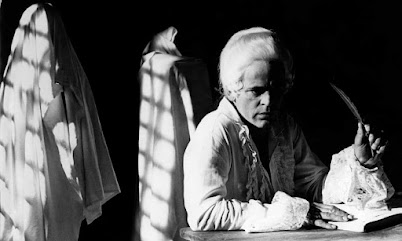
One overhears, in a Paris café (this actually happened), two waiters discussing whether an acquaintance is Cartesian or Pascallian: does he favor doubt or faith? All French, the French feel, are either one or the other, and we might rush to conclude that here are their real antecedents. 

Sartre
Let an enormous fartre
And sighed, "Descartes be damned.
I stink, therefore I am."


But regard the waiter as he separates himself from his confrere to “serve” you, the subtle brusqueness with which he lets you know you are intruding on his time, the culpable helplessness with which you submit while he removes, with balletic crispness, whatever is on your table, and asks you with a “Oui, m’sieur?” what you think you might want.

Do not offer him your French to sneer at. Only raise your eyes to meet his, gleaming down at you with casual malice, and you will find yourself face to face, there can be no doubt, with the Marquis.

Robert MacLean is a bad poet and an independent filmmaker. His recent The Light Touch is on Amazon PrimeTubi and Scanbox, and his 7-minute comedy is an out-loud laugh. He is also a novelist, a playwright, a blogger, a YouTuber, a film reviewer, a literary critic, and a stand-up comic poet. Born Toronto, PhD McGill, taught at Canadian universities, too cold, live Greece, Irish citizen. No brains, but an intellectual snob.

An elegant woman is a woman who despises you and has no hair under her arms.”—Salvador Dalí

The Light Touch on Amazon Prime

The Natural Wish to Be Robert MacLean


Catholics and Puritans

“Puritanism: The haunting fear that someone, somewhere, may be happy.”—H. L. Mencken
A fault line runs across Western culture. On one side the Puritan work ethic rules the economy; on the other it's something else. In America the line is the Rio Grande; the exception is French Canada.  In Europe the line is roughly defined by the Alps; the exception is Ireland. 

France, by this reckoning, is at the center of the world, where it belongs. England is across a narrow channel from a Mediterranean country.


So we might say that Catholicism, Roman or Orthodox, is that "something else," though it seems to me that religions arise out of peoples, not the other way around
—Nordic barbarians on the one hand, ancient civilizations on the other. South of the Alps people have been civilized—settled, living together, absorbing invaders—for four thousand years (the old polytheism peeks out from Catholicism), while our own ancestors were still roaming the Siberian steppes.

Shakespeare was a civilized man, yes, but his London was barbaric. The British as a people didn’t get there until Victoria, when Puritanism finally took hold. Civilization is middle-class; the aristocrat, Nietzsche tells us, is a barbarian. It’s fair to say that the British have been civilized for only a hundred and fifty years. Not long before that my people painted their faces before going into battle.
(See My Racial Profile.)

We mustn’t confuse Puritanism with prudery. Jean-Luc Godard, William Burroughs, Paul Schrader and David Lynch are Puritans, but their work can be pornographic. Vladimir Nabokov on the other hand was prudish, but in no way puritanical.


The Puritan is a dualist: soul/body, good/evil. The world, for a Puritan, is a temptation to be got through. The Catholic is a monist who believes in the earthly paradise. A few adjustments will restore it. When the Pope disembarks from a plane he gets down on his belly and kisses the ground. You won’t find the Archbishop of Canterbury doing
that.

Puritanism forbids images. An image is false. Truth is elsewhere. The sources of Puritanism in our culture are Moses and Plato. The second commandment forbids images. Plato banished image-makers from his Republic.


According to Freud’s theory Moses was a defeated Egyptian prince who led the Hebrew slaves away from image-saturated Egypt to establish a monotheism; but when he came down the mountain he found them backsliding, adoring an image, the bull calf—which by the way had also been worshipped in Minoan Crete, as it is today in India and Spain. (The bullfight, says Garcia Lorca, contra Hemingway, is “an authentic religious drama, where in the same manner as in the Mass, a God is adored and sacrificed.”)


To forbid images is to impose abstraction. All three puritan traditions, Judaism, Islam and Protestantism, emphasize reading and abstract thinking. The Muslims invented the zero, a huge feat of abstraction, and algebra, and gave us our numbers.


But the early Church, with illiterate peasants and slaves to reach, had to interpret the second commandment as not to worship “false gods.” Walk into a Catholic or an Orthodox church and there are images on the walls, in the windows, on the ceiling, on the floor. The first thing Puritans do is smash the statues and break the stained glass.


Without the Catholic tradition we wouldn’t have Giotto, Botticelli, Giorgione. There was no Jewish oil painter of note until Chagall. [Correction: until Velázquez.] In America, where abstraction is the rule, painting has been reduced to Jackson Pollock's bathroom tile.


Nor does physics permit images. The imagination is bound by Euclid’s laws: the shortest distance between two points, the three angles of a triangle. Newton built his universe in Euclid’s space. But when our telescopes became strong enough, and our cameras fast enough, to record the movements of galaxies, we saw that they did not obey those laws.


Imagine three equidistant objects: easy. Imagine four: a pyramid on a triangular base. Imagine five: can’t be done. And yet it is so. Five hundred, five thousand galaxies where they shouldn’t be: we cannot construct a model of our universe. We cannot imagine it.


The image induces orgasm. You imagine her even when you’re having her. You imagine her even when you’re
not having her. Hence the veil.

Twenty years ago in Afghanistan, despite the world’s outrage, the Taliban dynamited giant Buddhas carved in the living rock; they were images and they had to go. Muslims on the other hand were outraged by the Danish cartoons of the Prophet
—not so much that they mocked him as that he was portrayed in an image at all.

Jean-Luc Godard attacked images; it has been said that film was not his medium. William Burroughs did the same, and refused to be labeled an “entertainer,” though that is scarcely true. Still, these Puritans clear a space for the spirit. If there can be no adequate image of God, or of reality, then there can be none of you, which is comforting.


“I found America the friendliest, most forgiving, and most generous nation I had ever visited. We South Americans tend to think of things in terms of convenience, whereas people in the United States approach things ethically. This—amateur Protestant that I am—I admired above all. It even helped me overlook skyscrapers, paper bags, television, plastics, and the unholy jungle of gadgets.”—Jorge Luis Borges


The Puritan is a moralist; the Catholic, a mystic. Consider opera, that Catholic art, that rite that transubstantiates passion into music. What would Protestant opera sound like? It would sound like Wagner
—moralistic, amelodic, German. (See Germans.)

The Puritan believes in “character” in the sense, not of what distinguishes you from others, but of moral strength. You stand alone. Monotheism breeds the mono-self. In how many Catholic works (by “Catholic” I do not mean “Christian”) of Rabelais, Joyce, Picasso, does one self melt into another.


And so, in the Hollywood movie, we have the all-important “character arc",  in which the lead Learns Something. Are
you learning anything? You’re gathering skills, I know that, but how’s the penetration of mystery going?

An Irishman kills someone, and runs north. Burdened by his guilt he seeks out a clergyman and unloads. “You’ve done the right thing coming to me,” says the minister; “now you must give yourself up to the authorities.” “I’d rather not,” says the Irishman. “But you know that it’s my duty to tell them.” He runs. The police are behind him. He goes south and escapes. Still heavy with guilt he enters a church; the confessional light is on; he goes in and kneels in the dark. “Father, I’ve committed murder.” “How many times, my son?”


The Protestant public is outraged that the Church is not punishing more severely the pedophile priests. Character. “So that’s the kind of man you are!” But the Church believes in the forgiveness of sins, right here in the earthly paradise.


Let us not speak of Catholic and Protestant; let us speak of Nordic and Mediterranean. For the vulgarity north of the Alps is just as grotesque as it is in America.


Consider punching. Angry Mediterraneans shout at each other in the street in a manner that shocks Nordics, in that it never erupts into fighting. We barbarians love to punch.


Consider drunks. I live in Greece and so far I’ve met two drunks. Walk down the street in New York, Toronto or London and look around: we’re all drunks. In an Athens grocery store you can buy plain alcohol for disinfecting cuts and cleaning instruments; in those other cities you can get it in a drug store, but it has an obnoxious smell, so we won’t drink it.


Consider farting which, along with belching, is a mode of communication in the Anglo-Saxon world. In Mediterranean countries it’s simply not done.


Oddly, when you think of the disdain of which America is often the target (“America is the only country that went from barbarism to decadence without civilisation in between,” said Oscar Wilde), civilization took root on the seaboard before it did in northern Europe, planted there by Puritan middle class intellectuals. The United States is unique in that it is a country springing from intellectual principles.


Norman Mailer said Puritanism was the muscular contraction that brought us to the moon. But it exacts its price in the impulse to legislate morality—the Mann Act, Prohibition, abortion laws, the world’s biggest prison population (proportionately and numerically); in the missionary zeal with which it brings democracy to people who have no use for it; and in its conviction, right down to the bone marrow, that the movement of money is the action of God in the world. Bankers in Protestant countries are priests, their calling invested with high authority, and holy secrecy.


That's the kind of morality a cold climate can produce. The New Age library includes a host of books that will help us adjust our attitudes and become more deserving. (Character again: it depends What Kind Of Person You Are.) And today’s Republicans will stop at nothing to reduce the national deficit and regain divine favor. (See Lorca's remarks on Wall Street.)

Do you see this going away? I don't. American fundamentalists are a political force strong enough to have kept their President in office for eight years and, astonishingly, to have fought Darwinian evolution for a century. No one understands America’s difficulty with this, and it appears to exercise the best of the journalistic minds there. There's no contradiction between creationism and Darwin’s Theory; the Church accepted it a century ago, and the impermeability on this issue is disturbing in such a powerful country. (See The Accidental Monkey
.) 

Two fundamentalisms now confront each other, Islamic and American, degenerations, both, of once higher cultures. The incidence of suicide bombings on the one hand, and the gunning down of numbers of people at a time on the other, cannot but seem connected.


It was the Puritan poet John Milton who towered over English Romanticism, which was really a kind of secular Presbyterianism, and each of the poets (except the Shakespearean Keats), even Worsdworth in his quiet way, took Milton’s Satan as his psychological model, though Coleridge preferred wailing for him.


Thus was born the Byronic hero, the Puritan rebel our popular imagination inherits. Marlon Brando was its fiercest avatar, but the figure remains
—that lonely Puritan renegade is still our dominant model.

Here in Greece, as the world now knows, there is a splendid insouciance about money. At the supermarket, even at such formal places as the bank and the post office, if you don’t have the right change, “Pay me next time.” Which means forget it. There is such an elegance about that, but it makes us positively stutter to confront it.


The characters in my books, like me, hang out south of the Alps, not only because they're paradisiacs but because here they're a little beyond Big Brother's reach.


Ah, but the barbarians are again at the gates.


Afterthoughts:


1) What T.S. Eliot calls the “dissociation of sensibility” set in with the Puritan revolution—a schizophrenic scissoring of the mind from the sense of self on the one hand, and from the world, including the body, on the other. The corresponding Catholic psychosis is manic-depression. Fellini cuts on laughter and tears, and
resolves when Guido’s spirits simply lift.

2) "The romantic temper,” says Stephen Dedalus, “is an insecure, unsatisfied, impatient temper which sees no fit abode here for its ideals." Our own taste for parallel worlds, New Age projections and internet avatars is a case in point: life is elsewhere.


3) Find the mortal world enough;

Noons of dryness see you fed

By the involuntary powers,

Nights of insult let you pass

Watched by every human love.

—W. H. Auden, “Lullaby”


4) Comedy is the Catholic form, as in Dante; tragedy is the other thing. Robert Graves’s Protestant mother and Catholic father fell in love with a house in Wales: “Oh,” she said, “I could die here.” “Let’s live here,” he said.


5) See also Catholic Converts.


Robert MacLean is a bad poet and an independent filmmaker. His The Light Touch is on Amazon PrimeTubiScanbox, and YouTube, and his 7-minute comedy is an out-loud laugh. He is also a screamingly funny novelist, a playwright, a blogger, a YouTuber, a reviewer of films, a literary critic, and a stand-up comic poet. Born Toronto, PhD McGill, taught at Canadian universities, too cold, live Greece, Irish citizen. Committed to making movies that don't matter. No brains, but an intellectual snob.


In Praise of Older Women


Hemingway for Wimps

I’m thinking of writing a book with that title, about how to look death in the face and then run like hell.

Hemingway was the most important writer of the twentieth century—not the best, but the most important. Too schoolboy-magazine, really, but of world-class stature.

Well, what does “not the best” mean?  The novels haven’t held up. I love The Sun Also Rises, but it’s the only one that works these days, at least for me.

But the stories are up there with the greatest: Scheherazade, Boccaccio, Chekhov, Kafka, Hemingway. “The Short Happy Life of Francis Macomber”—is there a wilder, more gripping story? Gable and Peck both starred in film versions.

But that’s not the point. The importance of Hemingway was that he defined the American man, for the first time. Tom and Huck defined boyhood, not manhood. Arthur Dimmesdale and Natty Bumpo are versions of the British gentleman, meaning the British aristocrat, like Tarzan
—and were the only model American men had, and the world had, of American men.

Look at the heroes of the movies of the twenties. The most popular was Douglas Fairbanks, an American version of the British gentleman. Barrymore, Adolpf Menjou—ersatz Brits. Ronald Coleman—a Brit.

But in the thirties, when everybody’s read the novels, or heard of them, we have the emergence of Hemingway Man: Gable, Bogart, Cooper. Tough guys. "If you want to call me that, smile."

The British aristocrat, all old-world aristocrats, trace their lineage back to myth, to heroes and gods who slew monsters. Hemingway slew his own monsters—bulls, lions, charging buffalo, giant fish—he traveled the world seeking them out. It was very strongly felt by the young men who fought in Korea and Vietnam that you couldn’t be a man unless you had stood up under a shelling—“that chastening,” as he called it.

It is no exaggeration to say that what we call “the sixties,” the movement and broad social feeling roughly between 1966 and 1975, was a reaction against Hemingway, the minting of post-Hemingway man.  (Nor is it any exaggeration to say that the feminist movement that gathered such strength then was a reaction against the courtly love tradition, but that’s another story.)

There had always been guys like Teddy Roosevelt, “big-stick” guys, macho guys. Indeed, Graham Greene says that machismo is an inheritance from the Romans, and exists only in places that had been part of the Empire, and their colonies. 

But Papa wore macho with a glamour that seduced the world, and gave America, and American men—and their women—a specialness, an identity, a global profile.

Fitzgerald, who wrote the finest English prose since Shakespeare, and was a more generous man than Hemingway, who despised him, was shouldered out by Hemingway Man, and knew it, and resented it, and forgave it. Fitzgerald was the opposite of a tough guy, and therefore in competition with the British gentleman. He wrote very little that wasn’t designed to show that American class had more class than British class. 

But by the thirties, nobody cared. Indeed, who cares now? Name a recent American president, up till the sitting one, who isn’t cut from Hemingway’s cloth.

Ironically—for we must have irony, I can’t live without it—he finished life as a lesbian.

He became fascinated by lesbianism, put it in his novels and stories, and asked of his women that they treat him as one of them in bed. Well, it takes balls.

One of my English professors told us that the Hemingway mystique was false if it came down to blowing your own head off, but that’s unfair. Papa had been concussed and internally damaged in two back-to-back small-plane crashes in the jungle, and must have been in enormous pain, and in pain like that you can’t tell whether it’s physical or spiritual. Drugs, booze, shock treatments, going blind, I mean come on.

You’ve got to get out from under your heroes, and I think I have moved on from Hemingway. My characters are as wimpy as I am. But his presence is still there. Norman Mailer carried it for us until a few years ago. I leave you with this:

For more such idle verse see Literary Musings.

Robert MacLean is a bad poet and an independent filmmaker. His The Light Touch is on Amazon PrimeTubiScanbox, and YouTube, and his 7-minute comedy is an out-loud laugh. He is also a screamingly funny novelist, a playwright, a blogger, a YouTuber, a reviewer of films, a literary critic, and a stand-up comic poet. Born Toronto, PhD McGill, taught at Canadian universities, too cold, live Greece, Irish citizen. Committed to making movies that don't matter. No brains, but an intellectual snob.

I was beastly but never coarse. A high-class sort of heel.

The Light Touch on Amazon Prime